| Astronomers, artists, alchemists, doctors and farmers…the Muslims were a force to be reckoned with for centuries in Spain. Their only visible traces these days are intricate architecture, crumbling castles and a loud, drunken fiesta to ‘celebrate’ their bloodthirsty farewell, but in their heyday Al-Ándalus had a substantial impact on Spanish society.
Entering Spain via Ceuta, which had been handed over to the Iberian peninsula a year before in 710 AD, the Islamic invasion began in the south and south-east of the country and met with relatively little resistance, given that many aristocrats were able to keep their properties and income and even some of their power, particularly as the new settlers lived off taxes imposed on the population as a whole. The original Christian inhabitants of what used to be Hispania had more or less resigned themselves to their land now being in the hands of this alien race, who in fact were far from a peaceful bunch – over the next 40 or 50 years, they brought in numerous Arab, Syrian and Berber immigrants and there were a good deal of punch-ups between them.
Generally, the Arabs, although fewer in number than the Berbers - natives of North Africa - were the upper-class citizens, owning the most fertile land, occupying senior positions in the government and living in the biggest houses. They looked down their noses at the Berbers, considering them a common, uneducated race whose only useful purpose was to fight in wars. In practice, though, the Berbers, fed up with the Arabs’ snobbish attitude towards them, gave vent to their combative streak against their stuck-up fellow invaders.
Despite their superiority complex, the Arabs were not averse to marrying and having children with local girls. Back then, a typical Spaniard was blonde with blue eyes and, over the generations, as the Arab bloodlines became heavily diluted with European genes, few of the aristocratic heirs of Al-Ándalus had the trademark dark hair and eyes and olive complexion associated with the Middle East.
Al-Ándalus, as the Islamic invaders were known, quickly got their feet under the table and established political independence, a monarchy and armed forces with fixed salaries for the inmates.
King Alfonso II was less pleased about these strangers entering his country and throwing their weight about, and launched a strong attack from Asturias in the north, but eventually was forced to admit defeat.
However, even the disgruntled Alfonso II had to recognise that Al-Ándalus improved social and economic conditions for the 9th-century population of Spain, and although these were turbulent times as the people became hot under the collar about the push for conversion to Islam and the ‘arabisation’ of their culture, the invaders brought a great deal of useful knowledge with them, including medical science, art, architecture and farming methods, such as irrigation systems.
Plus, as time went on, the natives of Hispania began to realise that if they continued to follow their Christian faith, their duties were higher, so converting to Islam became attractive as a form of tax evasion and, naturally, spread rapidly.
Despite everything, the Christians and Muslims generally got along very well. The former could practise their religion freely, as long as they paid their taxes and did not insult the Prophet Mohammed, and led a more or less similar lifestyle with no particular oppression or restriction.
The Christian kings in the north continued to simmer inside about the Muslims having made themselves at home without invitation, and often attempted to beat them down, particularly in the early part of the 10th century, an era that saw a surfeit of battles and bloodshed. Yet the native Spaniards further south actually joined their new neighbours in fighting against the northern monarchs. Whilst the Muslims were unable to gain more territory up there, they at least managed to protect what they already had.
In times of peace, the harmonious coexistence of the Muslims and Christians continued. Thse very same northern kings, forgetting their earlier cries of “get orf my land,” sent their kids down to the court of Córdoba to learn some manners. Once they had got the hang of how to behave like respectable ladies and gentlemen, they were frequently married off to Muslims and converted to Islam.
Many of the Christian inhabitants found the literature, music and philosophy of Al-Ándalus fascinating and absorbed it into their own culture. They quickly became fully-integrated with the Islamic settlers and recognised as friends and neighbours, leading to them being rechristened mozárabes, which comes from the Arabic word musta’rib meaning, literally, honorary Arabs.
As one would expect, the southern region of Spain now known as Andalucía acquired its name from Al-Ándalus, although historians argue that the Islamic influence was not great in Andalucía, being merely limited to architecture, cuisine and various customs. In fact, there are thought to be more descendents of Al-Ándalus in what is now the Comunidad Valenciana and La Región de Murcia.
Aqueducts and agriculture The Muslim influence in Murcia is most notable in farming, particularly irrigation. Making use of the old Roman structures such as aqueducts and underground pipes, they also added their own, including canals and water-wheels, channelling the river Segura in a similar way to how the Egyptians did thousands of years ago with the Nile.
Alongside the considerable urban and industrial development that occurred during the Al-Ándalus period, more sophisticated farming techniques led to an agricultural boom. “Agriculture is the base of civilisation, and life in its entirety depends on it,” proclaims one famous text, and the cities provided substantial grants to enable farming to take off.
Rice fields – particularly those on the Pego-Oliva border and the wetlands between Xeraco and Valencia – were the work of Islamic farmers, who also brought citrus fruit, various vegetables – particularly aubergines and artichoke, figs, dates, apricots, sugar cane and different types of wheat into the country. Modern-day Spaniards also have the mediaeval Muslims to thank for being able to slip into a restaurant and order from a wide selection of homemade wines with a plate of olives to go with it. These settlers also gave a huge boost to the textile industry by harvesting cotton and flax.
Mind your language Today’s Spanish language contains numerous ‘Arabisms’ as a result of the long Al-Ándalus occupation, many related to their inventions and the plants they cultivated. Numerous towns and cities took names that are clearly of Arabic origin, many of which begin with ‘Al’ – Almussafes, Alzira, Almisserà – and Sueca, which comes from suayqa, meaning ‘mini market’.
Albahaca (basil), azafrán (saffron), azahar (orange blossom), almohada (pillow), aljibe (water well), alcachofa (artichoke), ojalá (if only, or, literally, if Allah is willing) are just a few examples, as is marijuana which, along with other narcotics, was given to patients by Muslim doctors before surgery to dull the pain – just one of the techniques in medicine that Al-Ándalus brought to Spain.
The mediaeval health service “The doctor treats, but God cures,” was the maxim that Muslim medics swore by, although their methods of treating were far superior than had been known to date in western Europe. They considered that the native Spaniards were lacking in theoretical knowledge and set about correcting it by intensive study, which involved travelling to the Middle East and Asia, visiting hospitals in India and Damascus, before returning to set up practices in Spain. They translated Greek texts, which they claimed were more thorough than the Latin ones used by the original Spanish population. They practised dissection to perfect their surgical techniques and it was the Muslims who discovered the circulatory system in the 13th century.
Even the poor were able to secure healthcare, as a fund administered by the Mosque was created using the profits from land and mills to pay for them, although many doctors did not charge for their services unless the patient was rich. These funds were also used to finance hospitals and pharmacies.
Doctors fell into three categories – the hakim held the highest rank, and was the most knowledgeable and able to perform surgery; the tabbib was the equivalent of what we now know as our local GP, and the mutatabib was the junior or assistant doctor.
Budding scientists, the Muslims studied astronomy, alchemy, mathematics, algebra, botany and biology, diffusing their knowledge throughout the country.
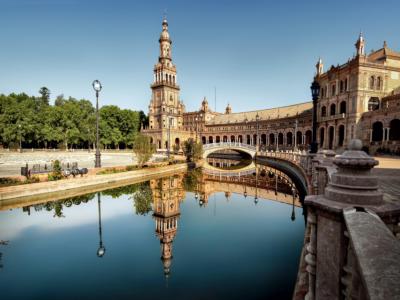
Arabic architecture Art and architecture was another legacy left by the Muslims – besides castles on hills and coastal watchtowers, strategically-placed to make invasion difficult, most towns and villages in eastern and southern Spain, and various parts of the north, have at least one monument that dates back to the Moorish occupation. Prominent examples can be found in Córdoba (the photo is of the Mezquita cathedral in Córdoba, which was originally a mosque), Sevilla, Cádiz and Granada – the most famous being the Alhambra palace.
An undignified exit The Arab rule only lasted until the middle of the 13th century when the Muslims were expelled from Spain, a move that seems as tricky as kicking the tourists out of Benidorm – in addition to the sheer number of them, their cultural influence and contribution to the economy was substantial.
However, this didn’t put Alfonso VIII of Castilla off – he launched a bloodthirsty attack in 1212 which saw the Moors running for cover, and his successor, Fernando III, snatched back Córdoba in 1236 and Sevilla in 1248, which spelled doom for the Muslims.
By 1250, the majority of Spain was Christian once again - those Moors who remained were forced to convert, and were since known as Moriscos.
Granada, however, managed to escape the iron hand of the ethnic cleansers until 1492, when Isabella and Fernando (better known to the British as the parents of Catherine of Aragón, one of Henry VIII’s wives) threw the remaining Moors out, together with the Jews, and imposed the Catholic faith on the entire population.
It’s nothing to celebrate, really Anyone who has lived in our area for more than a year will have seen the 13th-century battles re-enacted in the form of a colourful fiesta, the Moors and Christians. The bright, flamboyant parades with camels, horses, local bands and fireworks on the first day of the festival gets a bit violent later on in the week – sword-fights and a siege laid on a mock castle built for the occasion see those dressed up as Moors defeated year after year. Whilst there are a number of spectacular Moors and Christians parades throughout the region, the most famous is in Alcoi in March, a event that brings spectators in from all around the globe.
Perhaps it seems somewhat controversial to ‘celebrate’ an entire race whose descendants, culture and family history were deep-rooted in Spain being sent packing, but 800 years later it is undeniably a tourist magnet and a great excuse for partying and binge-drinking twenty-four hours a day for a week. |