| If you go down to the woods today, look out for evil elves, flying devils and blood-sucking witches…
Deep within the rolling emerald slopes of the Picos de Europa, tucked away inside the dense forests, hidden between the rocky shards of the immense gorges that slice the beautiful, verdant landscape of the unspoilt but much-visited region of Cantabria, lurk a number of creatures you wouldn’t want to meet on a dark night. Or even in broad daylight, really.
Just when you thought all Cantabrian people were friendly, welcoming and keen to show off their homeland to visitors from far and wide, you discover that there is a dark side to this spectacular part of the world that will send a chill down your spine faster than the eternal scotch mist.
Up there in the bracing north, where the landscape is more reminiscent of middle England or rural France than the Spain we are used to, some of the native inhabitants include viper¬-wielding giants, bloodsucking monsters, fire-breathing devils on horseback – which have nothing to do with dates wrapped in bacon – and cheeky little elves that are responsible for the disappearance of your pens and odd socks.
Fortunately, not all of Cantabria’s cave-dwelling creatures are out to kill or maim us, rip up innocent trees and scare the living daylights out of poor little field mice. Some are the proverbial do-gooders, committed to righting the wrongs of their roguish companions. Unicorns and fairies fight for justice in and out of Cantabria’s enchanted woods, whilst the Imp of Lost Items undoes the annoying work of the little chap who likes to hide our saucepans in the microwave and our shoes in the fridge by kindly placing all those objects we had given up for lost down the back of the sofa.
Although these colourful creatures were conjured up by Cantabrian folklore centuries ago, you will no doubt recognise their traits in other legendary characters that have crept into your own country or region’s mythology – particularly those which, like Cantabria, witnessed the passage of the Celts.
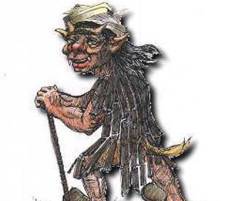
Now, where did I put…? Most of us have shared our homes with El Trastolillo from time to time. One of the most notorious figures in Cantabria’s story-telling tradition, the cheeky, smiling, playful imp, always seen in a white cap and carrying a wooden pole, is responsible for all the bizarre happenings in our houses. Items which disappear, ornaments that fall off shelves for no apparent reason, and noises in the night are all the work of the Trastolillo – and you’ll never escape him, even by moving house. He’ll follow you into your next home and carry on his mischief.
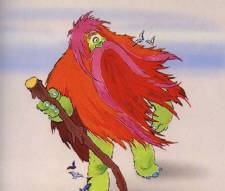
Goliath was handsome next to this lot Walkers in the woods should keep a careful eye out for the Ojáncano, a gigantic creature with a long red beard, on eye, ten fingers on each hand and ten toes on each foot, who passes his time destroying trees, houses, animals and birds. Ojáncanos carry wooden walking sticks like the Trastolillo, but can turn it into a viper, raven or wolf at will. They live in caves in rural Cantabria with Ojáncanas, the female of the species, who are monstrously ugly with long, matted red hair and survive by sucking the blood of children. Ojáncanos as a species cannot reproduce, but when a female dies she is buried at the foot of an oak tree and, after a few months, a plague of worms comes out of the ground that later metamorphose into baby Ojáncanos.
What the Devil…? Luckily, we are spared the presence of the Caballucos del Diablo for another year, as they only come out on June 23, the night of San Juan and the summer solstice. Seven red horses with long, transparent wings like those of a dragonfly, they carry the souls of seven wicked men – demons with skulls – bearing swords with which they make seven crosses in the sky to scare people. The Caballucos cause as much damage as they can, galloping in and out of the traditional hogueras or bonfires lit to mark the longest day of the year, ripping up entire fields and exterminating people who wander too far from their hogueras. The devil’s horses each have a different colour and when together, appear to form a perfect rainbow. Their spit turns to gold when it freezes, before it hits the ground, but if anyone tries to pick up this gold, he or she will go directly to hell.
Gimme chocolate One of the naughtiest and most curious – but fortunately, less dangerous – creatures of Cantabrian mythology is the Ijana. Next time you blame the kids for pinching the last chocolate biscuit, or the cats for nicking the smoked salmon off your salad plate, remember it could be the insatiable Ijana who, according to legend, sneaks into people’s houses at night to relieve the occupants of their weekly shop. Any type of food will do, although Ijanas have a particularly sweet tooth and are notorious for raiding beehives to suck out the honey.
Although they live in caves during the day, Ijanas are mostly found on the banks of rivers where they imbibe vast quantities of water to cure the indigestion they habitually suffer after gobbling up innocent householders’ secret donut stash. Those who have managed to catch a glimpse of the Ijana say she has transparent wings like a fly, one enormous breast that she has to hang over her shoulder, and is always naked.
Toil and trouble – or just an old wives’ tale? Cantabria’s witches come in all shapes and forms – there are those who have made a pact with the Devil and others who are simply wise elderly women, but all of them have extensive knowledge of spells and recipes for potions using plants and animals that they use to pass on their powers – good or evil – to those they consider merit them. As in many countries, legends featuring witches abound in Cantabria, although in practice they were just as likely to be faith-healers, heretics, spinsters or women who knew too much, whose fate was sealed by burning at the stake or drowning – practices that are well-recorded in ancient lore around the globe.
Flower fairies really do exist To redress the balance of the malevolent majority in Cantabria’s caves and forests, locals have the Anjana to thank. The archetypical Amélie, she thrives on spreading goodwill and solving problems. Loved and respected, slim, blonde and beautiful with vast wings that allow her to flit around the woods in the blink of an eye, the Anjana lives in palaces hidden within the rocks of Cantabria’s mountains. As they walk, they leave a trail of flowers behind them instead of footprints, and are capable of performing any type of magic or miracle thanks to a highly-versatile potion they carry with them at all times.
For an Anjana to solve your problems, you have to believe in them, but be warned – anyone who ill-treats animals or damages the environment will be severely punished by the blonde fairy.
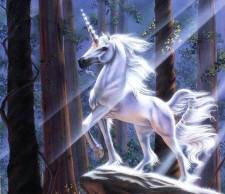
Round the horn Legends surrounding unicorns are rife in every society, but Cantabria’s strain of this mythical quadruped is fairly unique insofar as its horn is considerably longer and more upright, and its wings are on its fetlocks – hence its name, the Alicornio. Its horn is said to have the capacity to cure numerous illnesses and prolong life, but they are difficult to find as they live in the highest mountains of the Picos de Europa which are nearly impossible for humans to reach.
As in any fairy tale worth its salt, good wins over evil in Cantabrian legend. Far more benevolent characters exist than fiendish ones - like the Fish Man of Liérganes, the mermaid, the tree-hugging Musgoso, and the gold-weaving water nymphs or Mozas del Agua. Of course, the bird with eyes of fire whose looks can, indeed, kill; the Culebre, with his snake’s body and bat’s wings; the Roblón, or monster disguised as an oak-tree and the vampiress or Guajona make far more entertaining reading, even if they do induce nightmares.
Don’t let the evil imps, wicket witches and big unfriendly giants put you off taking a trip to this picturesque part of Spain, however. With its awe-inspiring scenery, quaint villages and clean air, even if you cannot find any Anjanas or Alicornios to protect you, Cantabria is Spain as you have never seen it before, and as you will certainly want to see it again.
Photos:
Photo 1: ALICORNIO - A unicorn with winged feet
Photo 2: EL TRASTOLILLO - The elf who nicks your odd socks
Photo 3: OJÁNCANO - Viper-wielding giants
Photo 4: ANJANA - A good-natured blonde fairy whose magic potions cure all |