| The capital of Andalucía does not even have to try to attract tourists. It’s a city with everything that newcomers to Spain imagined they’d find: Flamenco, tapas, year-round sun, festivals and large impressive monuments. Sevilla does not need to bother building holiday complexes to bring in the tourists; on the contrary, its inhabitants enjoy its attractions too and believe that the whole city should be welcoming.
THE CITY of Sevilla is situated in the southwest of Spain. It is the capital of Andalucía and the origin of many of the images that tourists retain when visiting this country. The sevillanas, tapas, sangría, buoyant spirits, monuments of every era, with thousand-year-old artistic tendencies, plus plenty of sun, which in summer makes it almost unbearable to visit. The spring or autumn, however, are perfect times to travel through Sevilla. The sunny streets invite you to stroll, there is less tourism and the different attractions – buildings, plazas and bars, all stay open for visitors.
A good day in Sevilla begins with a little history brought to life. The name of the city has its origin in the Tartesos (the ninth century BC), when it was called Ispal, and there is much to recommend in its buildings, and some great walks oozing with history.
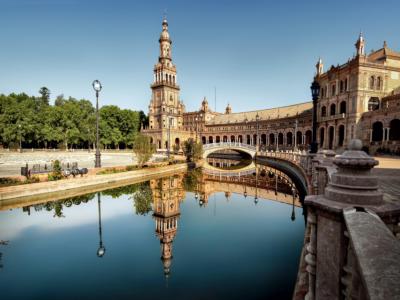
The Plaza de España is the best-known area internationally and one of the prettiest plazas in the country. It was created because of the Latin American exhibition of 1929 and takes many of its characteristics from this. Its semicircular form mirrors the welcoming reception Spain gave to its visitors, and at the same time by opening toward the river indicates the latters’ intention to continue sailing toward America.
To represent the four former kingdoms of Spain, numerous bridges cross the channel of the plaza, dividing it up, and all the provinces are represented in 48 banked areas. Each one of these spaces is decorated with representative symbols of each place, a map and the corresponding shield. It is interesting to travel through in alphabetical order (continuing left to right) paying attention to the decorative details. This plaza is considered a virtual tourist guide of Spain, since it took the form of an exhibition of Spanish achievements for the Latin American visitors.
The Plaza de España took 15 years to build and is supposedly one of the most beautiful representations of regionalist architecture. Red brick, local tiles and marble were used in its creation. It is the work of architect Aníbal González, who then resigned and left its completion to Vicente Traver.
To understand the cultural wealth of Sevilla and its importance on the historic map of Spain, pay a visit to the building of the Archive of Indias, previously called the Casa de Contratación de Indias. This name came from its activity as the regulating centre of commerce with the New World which necessitated the storage of numerous archives.
The port of Sevilla has international importance because of the Spanish expedition that departed from here bound for America. It was in 1492 when the Catholic monarchs said goodbye to the three ships, piloted by Christopher Columbus, as they left toward Asia. In reality did not they get to the Asian continent, but the American one, although the port of Sevilla retained the Puerto de Indias as its name.
Some years later, as a result, Sevilla became the European door to all the merchandise that arrived from America to Europe, when they established the Casa de Contratación de Indias. This symbolic building acted as trading office and traded all kinds of products and commercial activities. Under a meticulous process everything that arrived and left the port was detailed, as well as the men hired and the ships that came and went.
This era was known as the Golden Age in Spain and Sevilla derived its status from those times when it received all kinds of visitors and tradespeople. The wealth of the city was immense and culturally it became the centre of literature and Spanish painting.
Also at this time the University of Sevilla and the Cathedral were built. The latter occupies a great rectangle of 207 x 162 metres and on its façade you can distinguish baroque tendencies although the building is clearly Renaissance.
Tapas Although Sevilla’s impressive buildings and monuments are numerous, special mention must be made of eating out in the city. The sevillanos spend a great part of their leisure time in going out for tapas (a pastime known as ir de tapeo) an activity that should not be missed during a visit to the city. The origin of tapas was the idea of overing glasses of wine with a lid containing some morsels of food so that drunks would eat something (tapas translates as ‘covers’) although it is also said this was for hygiene reasons, since it stopped flies landing in the wine.
In any case, the current quantity of tapas that can be had in the city is incalculable and all depends purely on the wild imagination of the cook. From the typical spoon-sized tapas, that are small rations of the dish of the day, like the traditional gambas con gabardina (battered prawns). Food-wise, there is a whole world to discover.
Tapas can be enjoyed at any hour of the day, because in reality they are a snack but can double up as a meal, depending on the quantity and time of day. It is common to see the bars full of people at 10 o’clock at night, but at any time you are in a bar you can order extra tapas.
Typically in Sevilla the tapas is based on fish, in part as a cultural reference, although it is 100 kilometres from the sea. Most famous in Sevilla is the fried pescaíto, which comprises a variety of fish dipped in flour and fried in olive oil.
The best tapas are accompanied with a Chamomile tea, the typical beverage of the region, but you can also choose between many andaluz wines and beer. In Sevilla, the most-consumed brand is Cruzcampo, since the first factory of this brand opened here.
Another of the most popular tapas in Sevilla are the pavías of cod, which are also breaded and fried; mini fried tortillas with tiny prawns, or patatoes aliñás – boiled potatoes dressed with a sauce.
The Andalucía version of gazpacho, although consumed everywhere in Spain, originates from the south. It consists of a cold vegetable soup, rich with tomatoes, cucumber, green pepper and garlic. Gazpacho is sold in every supermarket and it is worth trying since cold soup is a novelty concept, and it contains a great boost of vitamins thanks to its fresh ingredients.
All the different neighbourhoods and most bars in Sevilla are ideal for trying tapas, but some are more traditionally-styled than others. If you have the opportunity, I would particularly recommend the bars in the neighbourhood of Santa Cruz.
Santa María de la Sede The Cathedral of Sevilla deserves a visit, whether or not you are Catholic; in fact it became a world heritage site in 1987. The cathedral is the largest one in Spain and the third-largest in the world, behind San Pietro in Rome and Saint Paul’s in London.
The magnitude of the building is heightened yet more when you consider the number of years it took to build. The project began with the demolition of the old mosque in the year 1433 and the first part was completed in 1593.
The tower and bell tower of the Cathedral of Sevilla, the Giralda, is known as The Weather Vane but really it is the minaret of the old mosque. Its height of more than 97 metres elevates it above any another building of the city, but curiously it has no stairs in its interior. To get to the top you have to walk up 35 ramps, sufficiently wide for the sultan to fit his horse inside.
Its architecture and ornamentation is a summary of the cultures that passed through the city, with a Muslim body, and subsequently added Renaissance and Gothic sections.
In the height of the tower, the figure of Giraldillo indicates the direction of the wind, hence the name of Weather Vane.
The Cathedral of Sevilla was the setting for the wedding between the Infanta Elena and Jaime de Marichalar.
The Bullring The bullring in Sevilla is one of the buildings most visited by tourists. It is the second-oldest bullring in Spain and the setting for the corridas that are celebrated during the Feria de Abril, the main festival of the city. According to bullfighting experts, the matadores have a great deal of respect for the plaza as it is considered the most difficult in the world, and loved by real fans.
Without doubt a visit to a bullring when there are no bulls is not a great spectacle, but you can get an idea of what it signifies to sevillanos and yet avoid seeing any harm to animals.
Royal Tobacco Factory Currently headquarters of the University of Sevilla, the old Tobacco factory constitutes an example of the industrial architecture of the 18th century. It is one of the largest of its kind in Europe and without doubt the biggest in Spain. When it was put in operation it gave jobs to a thousand people and tobacco originating from the Spanish colonies and Virginia was ground here.
Semana Santa Sevilla is a city with multiple religions from centuries past, but the one that has lasted longest and remains the tradition here is the Catholic religion. To express the feelings stirred by the death and resurrection of Jesus, Semana Santa – Easter week – is celebrated in Sevilla with more passion and abandon than anywhere else in Spain.
Various groups known as brotherhoods parade the image of Christ along the streets in the daytime, to the rhythm of beating drums, bearing the cumbersome weight on their shoulders. This activity, which could well turn out to be anecdotal, is carried at a snails’ pace and a third of the population of Sevilla participates each year.
Keeping pace with the images of the Saints, saetas are sung, typical expressions of mourning. Semana Santa is an expression of the Catholic religion that well deserves to be witnessed. The passion of the sevillanos and the immense turnout have led to a great and very popular festival that can even surprise and intrigue the atheists among us.
Flamenco and the Feria de Abril It is common to confuse flamenco with the sevillanas, but they are not the same thing. Flamenco is all the artistic expressions including singing, dancing, hand-clapping and instruments (guitar, box, castanets, sticks...) whereas the sevillanas are only singing and dancing.
In Sevilla the sevillanas are especially famous and popular, and they are danced during the Feria de Abril and many other festive occasions. The Feria de Abril is a great tradition and both sevillanos and foreigners alike enjoy them with admiration and amazement.
The fair begins when the entrance to the exhibition site is lit up. Each year the subject matter of the arched entrance is different, and it may be set alight in different ways. Inside the area, there are spaces called casetas, which are places where groups of friends can gather to eat and dance during the whole week.
Beside the casetas, the April fair continues as it did since it began, as a recreation site for the little ones, with attractions such as the ferris wheel, hobbyhorses and roundabouts. All these activities take place in an area known as the Street of Hell (Calle del Infierno).
Also, the fair has joint activities that are organised by the groups in the casetas. There are dance competitions and displays of horses and carriages, also sometimes in the form of contests.
Travelling in Sevilla The city is suitably compact for walking from one place to another to be relatively easy, but the heat and exhaustion mean a better option is public transport.
Although it may not seem like it, Sevilla can lay claim to more kilometres of bike lane than any other city in Spain and is one of the few that has installed a bike rental service, for which you pay a deposit to hire a bike for two days, or a week or more and can use it to travel throughout the city. When you do not need it you only have to leave it in one of the parking spots (aparcabicis) of the city. More information: www.sevici.com
How to get there Sevilla is very well connected from Madrid by means of the AVE (or high-speed train) in less than three hours. By boat, it is one of the few interior ports of Spain, where even large transatlantic ships can dock. The airport of Sevilla is some 12 kilometres from the city and has regular frequent services to Madrid and Barcelona. Also, the road that links Sevilla to Madrid is the TO-4 Madrid (538 km) and to Málaga the TO-92 / N-334 to (219km.)
Where to see spectacular flamenco
Casa Carmen C/ Marqués de Paradas 30. Tel. 954 212 889.
Casa de la memoria de Al-andalus C/ Ximénez de Enciso, 28. Tel. 954 560 670
Los Gallos Plaza de Santa Cruz. Tel. 954 216 981
Where to enjoy tapas Hundreds of bars are open all day and you can go in freely when you want and try some tapas. Once you are inside, consult the bar signs and try a portion – called una ración. If it is not to your taste, just enjoy the wine or beer and try another bar.
Some suggestions:
Kiosco de las Flores C/ Betis in Barrio Triana. La Judería C/ Cano y Cueto in Barrio Santa Cruz. Mordisco C/ Juan Sebastián El Cano in Barrio Los Remedios. Bar Santa Cruz in Barrio Santa Cruz |