Alicante/Cast./Valencia
Andalucia
Aragon
Asturias
Balearic Islands
Basque Country
Canary Islands
Cantabria
Castilla-La Mancha
Castilla-Leon
Catalonia
Extremadura
Galicia
La Rioja
Madrid
Murcia
Navarra
Animals/Pets
Business/Economy
Clubs & Societies, Charities, Hobbies
Community/Public Services
Crime/Incidents
Culture/Art/Literature
Education & Employment
Environment/Nature
Food & Drink
Health/Beauty/Fashion
Legal & Finance
Leisure/Entertainment
Politics & People
Property/House & Garden
Religion
Sport
Technology/Science
Transport (inc Motoring)
Travel/Tourism
  Spanish Property
  Business Directory
  Jobs
  Classifieds
WEATHER
CURRENCY RATES
POSTCODES
NEWS / FEATURES
CLUBS & SOCIETIES
 
Culture/Art/Literature back print tell a friend
Madrid’s golden triangle

By:
Destination Spain

Christmas is the best time to see Spain’s capital city at its sparkling, classy best. The stylish Madrileños parade in their finest (which is very fine indeed) to tour the shop window displays with the latest fashions and Christmas lights... and if you’re lucky, the festive ambience will be highlighted by snow on the ground and a bright sun in the sky. Yet Madrid is also the capital of culture and to make your visit even more complete, we suggest you visit the city’s magic triangle of museums.

Since Madrid entered the history books during the reign of Muhammad I, Emir of Córdoba (850-886), it has blazed an impressive trail. 
Each period of its history has left an indelible mark with architectural creations in a multitude of styles that have stood proud and steadfast with the passing of time.
But the city’s heyday came under the Bourbon dynasty, specifically with the reforms carried out by King Carlos III, fittingly referred to as ‘Madrid’s best mayor’.
The jewel in the Bourbon crown was the ‘golden triangle of art’, so-called because on a map of the city, the Prado, the Reina Sofía Museum and the Thyssen Museum are the three vertices of a triangular area of unsurpassable cultural heritage.
The three museums are only 10 minutes’ distance from each other – visit them all and let master painters including Velázquez, Goya, Miró and Picasso guide you through the splendid history of art on show:

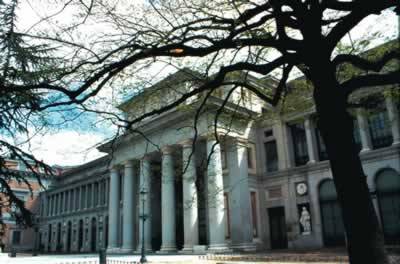
El Prado

El Prado as it is known today took a long time coming to fruition. The neo-classical building was constructed during the reign of Carlos III, under the direction of architect Juan de Villanueva, and was supposed to house a natural science museum.
The then royal painter Antón Rafael Mengs suggested that the building be used as an art museum instead, but neither project really got off the ground.
However, thanks to the subsequent initiative in Paris to house all its royal art collections in a new museum, the Louvre, the idea of an art museum for Madrid finally began to take shape.
María Isabel de Braganza, the second wife of Fernando VII, showed a personal interest in the project and was the driving force behind it - El Prado has always considered her as its founder, although she died before the museum was officially opened in 1819.
It was known at the time as the Royal Museum of Painting and Sculpture and housed more than 300 works of art, all of them from the Spanish royal family’s collections.
The initial collection soon swelled to over 1,500 pieces. King Fernando VII himself covered all the costs and opened the museum one day a week. However, you could only visit if you had been issued a special permit by his Court.
On the death of the king, the paintings were divided up between his daughters, Isabel II and Luisa Fernanda. In order to keep the collection together, Isabel II bought her sister’s share and declared the paintings Crown property so that they would not be split up in the future.
When the monarchy was ousted by the Civil War, the museum was nationalised and renamed Museo Nacional del Prado.
A new addition to the collection were the paintings from the Convento de la Trinidad, which had managed to bring together diverse works of art confiscated from the Church under the disentailment act introduced by Prime Minister Mendizábal in the 19th century.
Further purchases, transfers and bequests boosted the collection but there was concern about the lack of security measures for the now large and important collection, and there were real fears that disaster could strike at any moment.
Their fears were realised: a few months before the museum’s centenary celebrations, thieves got away with the largest heist in the Prado’s history, various works belonging to the Dauphin of France, brought to the Prado by his son Felipe V, first Bourbon king of Spain. Some of the works were recovered, intact, but others had been defaced to get at the precious stones encrusted in them.
The Civil War brought the museum’s growth to a sudden halt and some of the exhibits were actually moved to Geneva under the protection of the League of Nations (the UN’s predecessor). When World War II broke out, however, the works were returned home and after a tough post-war period the museum began to attract a constant stream of visitors, their numbers increasing every year.

The collections
Although the Prado was first intended to be a museum of painting and sculpture, it also now houses collections of sketches, etchings, coins and medals and almost 2,000 works of decorative art.
Nevertheless, the paintings still grab the limelight, even though because of a lack of space less than 15% of the collection is currently on show. The work is displayed in various different sections: Spanish, Flemish, German, French and Italian art, decorative art, sculpture, and sketches and prints.
Perhaps of all the Prado’s treasures, the ones that attract the most visitors are those in room number 12, given over completely to the work of Diego de Velázquez.
Here you can see his early work alongside the canvases he created as painter to the court of Felipe IV. The centrepiece of the room is the Las Meninas (the Maids of Honour) sometimes called The Family of Felipe IV, in which the artist himself appears. This is unquestionably one of the museum’s greatest works of art.
Other great masters including El Greco, Francisco de Goya, Zurbarán, Murillo, Rubens, Tiziano, Durero and Rembrandt also occupy part of the limited space.
In more recent years plans have been made to solve the space problem that has dogged the museum all along. The neighbouring Casón del Buen Retiro has become new home to some of the paintings and soon the cloisters of the iglesia de los Jerónimos will also house exhibits.
The Prado is currently hosting a Manet exhibition, the first of its kind in Spain, which will run until January 11 of next year. It offers a unique opportunity to study the particular style of this French impressionist, one of the 19th century’s most original artists.

Museo Nacional Centro de Arte Reina Sofía

History
The National Reina Sofía Art Museum is housed in Madrid’s one-time general hospital, Felipe II’s idea to bring all of Madrid’s hospitals together under one roof.
The project was not a great success though and when Carlos III came to the throne he commissioned architect Francisco Sabatini to hugely extend the building, incorporating seven courtyards and a church.
On his death the work was halted and the building reverted to a hospital for the next two hundred years.
It was not until much more recently, in 1986, that the building opened its doors as an arts centre. Two years later the three striking glass and steel lift towers were added and eventually, on September 10 1992, King Juan Carlos and Queen Sofía officially opened the centre’s first permanent collection to the public.

Permanent collection
The second and fourth floors are given over to the permanent exhibits. The former displays works that show how Spanish art has evolved over the years, from the end of the 19th century until after World War II, and the place it occupies in the international art world.
The centrepiece of this collection is room number 6 which houses Pablo Picasso’s work. In this popular gallery you can move through the artist’s different periods: his blue (1901-1904), rose (1905-1906), and cubist (1908-1916) periods, the period when he grew close to surrealism (1925-1935), and also the period between 1936 and 1945 when he painted Guernica, one of the masterpieces of modern art.
The Spanish Government commissioned Picasso to produce a large canvas for the 1937 International Exhibition in Paris. The brilliant artist took his inspiration for what has become his most well-known painting from the civil war bombings in the marketplace of the Basque town of the same name.
The museum has been bequeathed important works by two other geniuses of modern art: Joan Miró and Salvador Dalí. Miró’s work is housed alongside the Picasso gallery, in two sections – the work he did before World War I and that which he produced afterwards.
Joan Miró left Spain for France in 1919 and became part of the Paris art scene, and after his surrealist and collage periods he developed a very individual style, quite different to that of any school around at the time.
Also on display are the 56 paintings Salvador Dalí left the museum in his will in 1982. In 1928 Dalí was another Spanish artist who moved to Paris and there developed his paranoid-critical transformation method – a technique involving seeing the world around you while in an induced paranoid state – which he used as a basis for his own art form.

Thyssen-Bornemisza Museum

History
The Thyssen-Bornemisza collection was started at the end of the 19th century, when first Hans Heinrich Von Thyssen’s grandfather and then his father began to build up the family collection of paintings and sculptures.
It was housed in the Villa Favorita in Lugano, a property owned by the family in Switzerland, until the end of the 1980s when a larger home was needed for the constantly expanding collection.
In 1988 the family signed an agreement with the Spanish state to loan 775 paintings from their collection to Madrid’s Palacio de Villahermosa for a period of nine and a half years.
The Baron, and in particular his Spanish wife Carmen Cervera who shared her husband’s passion for art, were so pleased with the handling of their collection in Spain that just five years into the agreement they decided the collection should remain there permanently, making the Spanish Government the owners of one of the largest private collections in the world.

The collection
Almost all the Thyssens’ works are on exhibition in Madrid. Their primitive paintings from various different European schools, 20th century vanguard paintings, and their North American 20th-century art have gone a long way to filling gaps in Spain’s national art collection.
In the entrance to the museum you may be amused to see portraits of the Baron and Baroness Thyssen-Bornemisza, by Macarrón, alongside a portrait of the Spanish Monarchs, Juan Carlos and Sofía.
The Thyssen Museum opens up to the visitor more than seven centuries of the history of art, starting with the oldest works on the second floor and finishing with 20th century art on the ground floor, from the turn of the century vanguards to the pop art of the sixties.
Worthy of special mention are the Italian, Dutch and German collections.


Friday, December 10, 2004

Latest Madrid News
'Hospital bug killed18 Doce de Octubre patients'
Health/Beauty/Fashion - (11/5/2008)
Grand-daughter arrested after fatal stabbing
Crime/Incidents - (11/5/2008)
Spain sends thirteen tonne aid package for Burmese cyclone victims
Clubs & Societies, Charities, Hobbies - (9/5/2008)
 
Latest Culture/Art/Literature articles
Medieval shipwreck found in Barcelona city centre
Catalonia  - (11/5/2008)
Sotheby's sell Sorolla painting for $4.5 million
Alicante/Cast./Valencia  - (8/5/2008)
Odyssey treasure ship and site confirmed
Spain  - (8/5/2008)
 
  back


Spanish news archive Costa Blanca news Costa del Sol news Alicante news Castellon Valencia news Barcelona news Catalonia Costa Brava news Madrid news Tenerife news Canary Islands Malaga news Marbella news Andalucia news Sevilla news Costa Almeria news Murcia news Costa Calida Aragon news Asturias news Balearic news Mallorca Menorca news Ibiza Basque news Bilbao Cantabria news Castilla La Mancha news Castilla Leon news Extremadura news Galicia news La Rioja news Navarra news Spanish Travel Tourism news Spanish Property Spain directory services Spanish A B C D E F G H I J K L M N O P Q R S T U V W X Y Z Jobs in Spain Postcodes Spanish weather Spain History Spanish Culture Flamenco dancers Sevillanas Bullfighting bullfight bull fighting matador bullfighter Spanish Education Spain Schools Facts about Spain Clubs in Spain mortgages Spanish bank Spain banking Spanish banks Spain inheritance Spanish wills Spanish healthcare in Spain Working in Spain work Spanish employment Driving Spain cars Spanish car Spain Tax & Spanish Residency Property in Spain for Sale Spanish property to rent Spain holiday lets Spain news Spanish Properties Spain info Property Spain costa blanca 1 2 3 4 5 6 7 8 9 10 11 12 13 14 15 16 17 18 19 20 21 22 23 24 25 26 27 28 29 30 31 32 33 34 35 36 37 38 39 40 41 42 costa del sol 1 2 3 4 5 6 7 8 9 10 11 12 13 14 15 16 17 18 19 20 21 22 23 24 25 26 27 28 29 30 31 32 33 34 35 36 37 38 39 local news/info Spanish estate agents Off Plan property Spain | costa blanca property sales properties for sale real estate costa blanca villas | costa del sol property sales properties for sale real estate costa del sol villas | costa de la luz property sales properties for sale real estate costa de la luz villas | costa brava property sales properties for sale real estate costa brava villas | costa almeria property sales properties for sale real estate costa almeria villas | costa calida property sales properties for sale real estate costa calida villas | costa valencia property sales properties for sale real estate costa valencia villas | costa azahar property sales properties for sale real estate costa azahar villas | costa dorada property sales properties for sale real estate costa dorada villas | costa garraf property sales properties for sale real estate costa garraf villas | costa maresme property sales properties for sale real estate costa maresme villas | costa vasca property sales properties for sale real estate costa vasca villas | costa verde property sales properties for sale real estate costa verde villas | costa da morte property sales properties for sale real estate costa da morte villas
 
© 2003-2008 Think Web Content, S.L. - All rights reserved