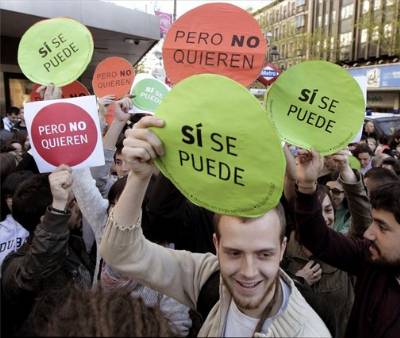
Judges call 600,000-euro fines for 'personalised' protests or photographing police 'repressive' and 'autocratic'
Judges call 600,000-euro fines for 'personalised' protests or photographing police 'repressive' and 'autocratic'
NEW legislation attempting to limit public demonstrations and imposing fines ranging from 30,000 to 600,000 euros for 'insulting a police officer' or 'protesting in public without authorities' consent' has been slammed by judges, pressure groups and even the police themselves.
The association Judges for Democracy likens the Law of Public Safety to legislation passed during dictator General Franco's era which effectively censored freedom of speech.
These top-level legal professionals say the move is almost certainly against the terms of the Spanish Constitution and leaves ordinary citizens 'defenceless'.
And sanctions for non-compliance are 'tantamount to destitution' on the part of the accused, say judges, because one single fine would 'wipe out a person's entire assets'.
They add that a person facing a fine under the Law of Public Safety would have no choice but to try to defend themselves in court, which would involve extremely high legal costs, particularly as court taxes for anyone bringing action to defend themselves have now shot up.
Members of the opposition in government say the legislation is effectively a 'gagging order' on the public.
Head of the countrywide pressure group Plataforma de Afectados por la Hipoteca, or PAH ('mortgage victims' association'), Ada Colau says the contents of the new legislation and the 'disproportionate' fines threatened are merely a way of stopping people from expressing their discontent about unpopular government policies.
And instead of changing their unpopular policies, the government is seeking to frighten into silence anyone who complains about them, Colau states.
Judges say the law is effectively 'criminalising dissidence', is 'unnecessary', 'repressive', 'autocratic' and 'has nothing to do with public safety'.
“Instead of attempting to convince the public that their policies are effective and for the best, the government wants to criminalise those who disagree with them,” a spokesperson for Judges for Democracy stated.
One of the actions now subject to a fine of between 30,000 and 600,000 euros is that of staging a 'personalised' protest against a given authority figure, a recent phenomenon known as an escrache – where demonstrators target politicians one by one, staging their protest outside their homes.
Police and judges both stress that such a fine is 'out of proportion' since an escrache is neither a criminal nor a civil offence per se.
Holding a demonstration outside a politician's front door only becomes a civil offence if trespass occurs, or a criminal one if vandalism or injuries result from the protest action.
In the overwhelming majority of cases, says the police union SUP and Judges for Democracy, an escrache or personalised protest is merely a little noisy and no harm is done, meaning there are no legal grounds to fine or arrest anyone involved.
According to the SUP, the government is attempting to suppress escraches purely and simply because the people they target are, in fact, members of the government.
Fines of between 30,000 and 600,000 euros can also be imposed where protesters take photographs or videos of police officers in the course of their duty.
In cases reported of police violence against peaceful protesters, these images are the only evidence demonstrators have to prove they were the victims of physical assault, says the PAH.
All demonstrations which are staged without prior consent from the State – which it now reserves the right to deny – are also subject to fines that could exceed half a million euros.
The Spanish Constitution includes the right to hold demonstrations within its section on freedom of expression, and publicly disagreeing with the government is not a crime or a civil offence in a democracy, insist the judges.
Ada Colau of the PAH has announced that if the Law of Public Safety – which she and the judges say has nothing to do with 'safety' and everything to do with repressing public opinion – is passed and comes into effect, the PAH will join forces with all other pressure groups in the country to stage a National Day of Disobedience in which mass demonstrations will be organised of exactly the type the government wishes to impose fines for.