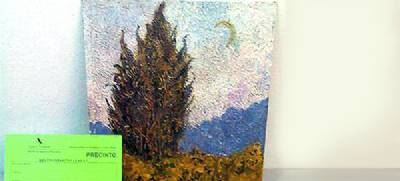
Van Gogh painting missing for 40 years found in tax evader's bank vault
Van Gogh painting missing for 40 years found in tax evader's bank vault
TAX authorities discovered a missing original Van Gogh painting during an inspection of the assets of an individual accused of a multi-million-euro fiscal fraud.
Back in October, the tax office - Hacienda - announced the imminent seizure of 542 safe deposit boxes in 270 bank branches, belonging to a total of 551 people and companies, which would lead to the embargo of 319 million euros' worth of goods and funds.
Two months later, a painting thought to be a Van Gogh 'of incalculable value' which disappeared from the Kunsthistorisches Institut in Vienna in the early 1970s was found in one of the bank vaults.
Experts have now studied the picture carefully and confirmed this weekend that it is in fact the 1889 painting Cypress, sky and field, created by the Dutch artist during his so-called 'mad period' when he was a resident at the mental health institute in Saint Rémy de Provence, France.
Vincent Van Gogh's stay in the asylum came just a few months after he cut his left earlobe off in reaction to finding out his love for French artist Paul Gauguin was unrequited, when the latter ran away to Tahiti to live among a harem of native women.
The period in the institution in Saint Rémy saw Van Gogh create numerous landscapes with cypress trees, including the famous Starry, starry night, the subject of the well-known song.
After the tax office found the painting, the person renting the bank vault said it belonged to a 'foreign millionaire' who brought it to Spain in 2010 and that he was 'merely holding it in safe deposit' on that person's behalf.
Art historians have confirmed the shaky signature on the painting was indeed that of Van Gogh during his 'mad period' and three stamps on the back of the panel - just over a foot square in size - support the holder's story of where it had come from and who had it.
The oldest of these stamps, in red wax, corresponds with the Rijksmuseum in Amsterdam and is dated April 8, 1944, during the Nazi German occupation of The Netherlands and another - from the Museum der Schöne Künste (Fine Arts Museum) in Berlin is undated.
Finally, the third one is stamped by the Institute of Art History of Vienna University (Kunsthistorisches Institut der Universität Wien) on April 10, 1974, which was when it went missing.
All three stamps were found to be authentic, which effectively means the painting also will be.
This discovery is a first for the tax office, although authorities say it is 'not unusual' for genuine works of art to be voluntarily handed over as public assets in order to settle tax bills.
An inventory carried out in 2012 by Spain's government of tax payments made 'in kind' over five years revealed three works by Picasso, two by Mirò and one by Madrazo, among many others, as well as numerous other items such as 15 outfits by famous Spanish designers including Jesús del Pozo and Ágatha Ruiz de la Prada.
So far, Hacienda has embargoed 357 bank vaults, having physically opened 154, allowing it to claw back two million euros in taxes from bank notes found there and from their holders having paid up in cash in person at the tax office to avoid their boxes being opened.
Other works of art, and jewellery in 17 vaults, have been discovered and 106 are waiting to be opened through a court order after their holders refused to allow the tax office to do so, whilst the holders of 87 vaults have yet to be traced.