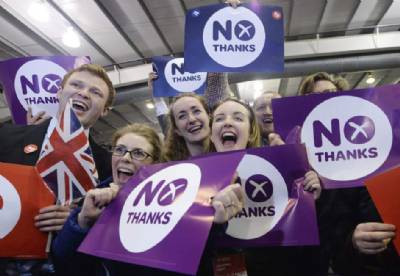
Catalunya's president says 'at least they were allowed a voice', whilst Rajoy congratulates the Scots for 'choosing security and union over uncertainty'
CATALUNYA'S president is far from deflated at Scotland's having said 'no' to independence – he has praised the UK for giving Spain a 'lesson in democracy' by allowing them to vote.
Meanwhile, Spanish president Mariano Rajoy has congratulated Scotland for 'avoiding the serious consequences' of secession.
“We need everyone, and we're very happy that Scotland is staying with us and with the EU,” Rajoy stated this morning after the results of the referendum were made public.
“Scotland has chosen between segregation and integration, between isolation and openness, between stability and uncertainty, betweeen safety and certain risk.
“And they've chosen the most favourable option for everyone: for themselves, for the rest of the British citizens, and for Europe as a whole,” Rajoy states.
Independence from the United Kingdom is likely to have brought 'serious social, economic, institutional and political consequences' if the 'Yes' vote had flourished, Rajoy believes.
Spain's Secretary of State for the EU, Íñigo Méndez de Vigo, says the 'No' vote having won out is 'great news for everyone who has spent decades working together on building Europe'.
As for Catalunya's president Artur Mas, he considers that Scotland's 'No' is not necessarily a 'shadow' lurking over the north-eastern Spanish region's progress in the independence bid.
“Voting unites, rather than separating, and Rajoy's greatest error is wanting to veto this vote using only the country's legal structure,” Mas stated.
Scots would not necessarily agree that voting 'unites rather than separates', however: most report that families and groups of friends are divided with constant arguments and tension, and that whichever way the vote went, it would be sure to result in a divided Scotland.
“What we've seen in Scotland is the only way to resolve conflicts and differences,” says Mas, who is unaware of the feuds, fall-outs, threats and even violence that the referendum in Scotland provoked.
During his speech in Spanish, catalán and English, Mas insisted that Scotland's 'great lesson in democracy' had 'reached the whole world'.
“It's not about whether you win or lose by voting – it's about how, whichever way it goes, you've won or lost democratically. And every time Madrid says 'no' to the Catalunya referendum, they're creating more and more political and social adversion – instead of resolving the issue, they're aggravating it,” the regional president states.
“And please don't think Scotland's 'No' is a shadow lurking over the process for Catalunya – we actually feel it has reinforced our campaign, due to the fact that Scotland was allowed to vote.
“It's not that Catalunya wants to become independent right now – we just want to vote on whether or not this is what the people want.
“If the Scottish 'Yes' vote had flourished, we would have had a clearer path to show us how cases of this type are handled – but the 'No' vote having won still paves the way for us because, in Scotland, the people have been able to vote and those who have lost have to accept it democratically since they were, at least, allowed a voice.”
The 'Yes' campaign won 44.7% of the votes and the 'No' brigade, 55.3%, meaning it was almost neck-and-neck, but only four out of 32 constituencies gave the 'Yes' vote a clear majority.
Key 'No' voters included former Labour prime minister Gordon Brown, who comes from Scotland originally.