Teresa discharged from hospital and says Spain's health service is 'capable of miracles'
Teresa discharged from hospital and says Spain's health service is 'capable of miracles'
NURSE Teresa Romero has been sent home after a month in the Carlos III hospital in Madrid, of which 25 days were spent in isolation, and says Spain has 'the best healthcare system in the world'.
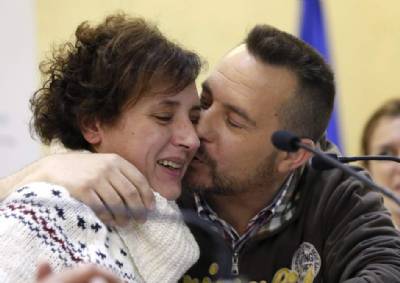
During a brief press conference upon being discharged, the 44-year-old from Alcorcón (Madrid), who caught the deadly Ebola virus whilst treating missionary doctor Manuel García Viejo, 69, after his repatriation from Sierra Leone, said: “Despite the nefarious political management, here in Spain we have the best healthcare in the world, capable of working miracles. And I'm one of those.”
Teresa survived against the odds after a touch-and-go 48 hours when her work colleagues at the Carlos III, who were treating her, thought they were going to lose her.
Sitting in a wheelchair and still very weak, but completely free from Ebola and with her organs working properly now, Teresa profusely thanked each and every staff member by name, from cleaners and porters through to nurses and doctors.
Now the virus has left her, Teresa will not pass Ebola to anyone who comes near her – and in fact, her blood may be needed elsewhere in the world to cure others suffering from the lethal haemorrhagic disease.
“If my infection has served any purpose, for researching the illness better to be able to help find a vaccination, or if my blood can be used to cure other people, I'm here until it runs dry,” Teresa announced.
She was successfully treated, partly with the experimental ZMapp serum and partly with blood from Equatorial Guinean nun and doctor, Sister Paciencia, who made a full and miraculous recovery in Liberia.
The Madrid nurse said she wants to meet her and 'give her a hug', adding that she will 'never be able to thank her enough'.
She says she is willing and able to help in the fight against Ebola, be it treating other patients or offering herself for research or her blood as a cure.
Teresa adds that when the two Ebola patients Manuel García and Miguel Pajares, 75, repatriated from Liberia, were admitted to the Carlos III, she offered herself voluntarily to help in their care 'even at the risk of putting her own life in danger'.
“When I saw I was dying, I clung to my memories, to my family, my husband whom I adore. I was isolated. I had no more contact with the outside world than with Javier, via telephone, and the love and affection of the professionals looking after me,” she admitted.
Concerning how she became infected at all, Teresa says she 'does not know what went wrong' or 'even if anything went wrong', but stresses she does not hold any grudges.
Her husband Javier Limón took over the microphone after she had read out her statement, saying he would contine to fight for justice for the couple's dog, Exkálibur, who was put to sleep by the regional health authorities without justification.
As well as causing pain and grief to Javier and Teresa, Exkálibur's fate meant Spain had lost a crucial opportunity to study the evolution of the disease in animals, Sr Limón stated.
He referred to Bentley, the dog belonging to Dallas nurse Nina Pham who is now out of hospital after recovering from Ebola.
Bentley was cared for by a veterinary nurse in quarantine, played with and given attention several times a day to make him feel at home, and tested regularly.
He has now been reunited with Ms Pham, having shown no signs of the disease and tested negatively twice.
Javier has started a petition on www.change.org, which had already gathered over 86,000 signatures by Monday.
He concluded by saying that he and Teresa would now be going away for a few days to relax, to somewhere the media 'would not be able to find them', as they now want some peace and quiet until Teresa has fully recovered from her ordeal.
Spain is now, technically, free from Ebola, but is not considered 'officially clean' until twice the incubation period has passed after the last sufferer in the country has either died or been cured.
Teresa was declared Ebola-free on October 21, and the incubation period is three weeks, meaning that if nobody else in the country is diagnosed the World Health Organisation (WHO) will declare Spain as being cleansed of the virus in the first week of December.