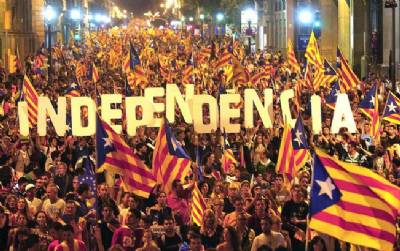
No majority in Catalunya's elections, but pro-independence coalition wins the most seats
No majority in Catalunya's elections, but pro-independence coalition wins the most seats
MIXED results of the regional elections in Catalunya mean the pro-independence brigade is in a stronger position than ever, but no single party has won an outright majority.
Current regional leader Artur Mas, head of Convergence and Democracy for Catalunya (CDC) and Oriol Junqueras of Catalunya Left Republicans (ERC), whose strategy involved bringing together all bar one of the parties who were in favour of secession under the heading of Junts pel Sí ('together for the 'yes' vote') has in some ways succeeded – of the 68 seats needed for a complete majority, they have gained 62, with 47.86% of the votes – but in others failed, since they won 70 seats at the 2012 regional elections, meaning a loss of eight.
The remaining pro-secession party, CUP (Candidature for Unity of the People) which decided to go it alone won 10 seats, compared to just three in 2012, meaning in theory, if it hooked up with Junts pel Sí in coalition, those in favour of unilaterally declaring independence would have a full majority with 72 seats.
But CUP leader Antonio Baños has already said his party would not back Mas as regional president in the in-house elections which will take place between now and early November.
Without either a minimum of 68 seats or a coalition agreement with CUP, Junts pel Sí's strategy for Catalunya's secession from Spain cannot get off the ground.
Ciudadanos, the centre-right independent party which burst onto the national scene this year in time for the local and regional elections and intends to run for national government in December, has been present in Catalunya for nine years and is now the second-strongest party in the region's Parliament – an opposition with 25 of the total of 135 seats.
The socialists, PSC, suffered the least-devastating loss of seats, dropping from 20 to 16, and is the third-strongest outfit in the regional government.
Catalunya Sí que es Pot ('Catalunya yes it can be done'), a regional faction of left-wing independents Podemos, has run for each regional elections this year for the first time, and is disappointed with its 11 seats, but this puts them on level pegging with the PP.
In the case of the PP, which is in power in Spain's national government at present, the far-right party's representation in Catalunya has now plummeted from 19 seats to 11 and is no longer one of the main political forces in the region.
Unió, which used to be coalition partner with CDC under the name of Convergence and Union (CiU), barely scraped 2.5% of the votes and now has no representation at all in Catalunya's Parliament.
What the future now holds for Catalunya is likely to be subject to debate regionally and nationally over the next few weeks.