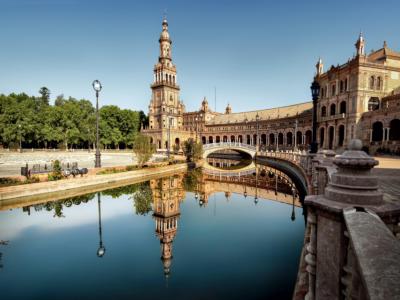
| If one word could sum up the Semana Santa (Holy Week) processions that grip Spain during Easter Week, it would have to be extraordinary! Nowhere else in the world are Easter processions celebrated on such a grand scale, all painstakingly planned and meticulously rehearsed. Semana Santa is celebrated all over Spain from Domingo de Ramos (Palm Sunday) to Domingo de Resurrección (Easter Sunday). Processions of varying splendour and size will grace the streets... one of the biggest and most impressive being the processions or pasos of Sevilla. Streets are crammed with people, balconies overflow and doorways are bursting. Yet this does little to ward off devotees who come from miles around to witness the processions, bagging their spaces and waiting patiently for hours. The highlight of the event is to catch a glimpse of one of the many ornately-decorated religious floats bearing the melancholic faces of the Virgin Mary or Jesus that pass down one street to the next. Women break out in their mournful saetas, highly religious Catholic songs usually sung without any accompaniment. When sung by a good flamenco singer or cantaor, they can be extraordinarily beautiful and soulful as their virtuoso vocal acrobatics fill the silence. I first visited Sevilla last November when there were still six months to go until the important week. On route to my hotel I saw a band playing in one of the many Sevillana small squares that lie in the heart of the old city. When I asked the taxi driver if there was a fiesta that day, he explained that in Sevilla, preparations for Semana Santa start the day after the previous Semana Santa ends. Stunned at what I had just heard, I decided to change the plans I had for my two-week holiday and to dedicate them to investigating the Easter preparations. I visited churches, saw many people - young and old - polishing silver, fitting and deciding on an appropriate way to lift the heavy floats, while bands were tuning up and practising their processional hymns. Lists of the nazarenos (the penitents dressed in long, hooded tunics) were being drawn up and nobody was having a moment’s rest. All this and it was still only November! After my two-week learning experience I promised to return to Sevilla in Holy Week to witness the results of such fastidious preparations. On my first evening I headed for the streets that were so charged with energy and passion. Turning the corner, I saw the sight that everyone had come to see: I shall never forget the overwhelming wonder I felt as a float of the Virgin Mary passed and the immense crowd hushed in awe of the spectacle. I consulted the little book I had bought that described each of the pasos or processions and found out from the description of the place and time that this was the Estrella paso. An old man explained to me that Estrella was the only float that had never missed a Semana Santa, even during war times. The statue of the Virgin on the float was white, beautiful, pure. It even seemed as though she was looking at me and a shiver ran down my spine. That week I went to the streets early every morning but they didn’t seem the same as the previous night. Now the locals were going among their daily business as if it wasn’t Semana Santa at all. Yet in the afternoon the activities began to commence again, ready to start another evening of processions. The many processions I saw included:
The San Gonzalo float. In stifling heat the band played, the people hushed and then clapped as the float passed. Two hours seemed like minutes. It was well worth coming to see it. The well-known Cachorro float, with a solemn, majestic and radiant Christ, accompanied in its path by a multitude of people. The Silencio, with its large crucifix, passing in silence as its name indicates, only the footsteps of the float bearers could be heard. The Gran Poder, called the Se or Sevilla, silent, regal, which as it passed caused many to fall to its feet and pray. The Resurreción float on Easter Sunday, Christ resurrected, and the Virgin in white, solemn but happy. I had heard much talk of the Madrugá that runs from Thursday night until Friday night, but we have to be there to understand what it’s all about. People are exhausted after spending four days in the street. Some eat, others rest, and amazingly, some take their places for the processions of the night the day before. When I returned to my hometown of Valencia on Easter Sunday, ready to start the working week, I felt so moved by the experiences during my time there that I was already booking my holidays for this year to return to Sevilla and the Semana Santa processions.
How to get there
Sevilla has an international airport with many direct flights: Telephone: (+34) 954 44 41 28 / 954 44 41 29 The airport also has a fleet of buses shuttling to the city centre: Telephone: (+34) 954 44 90 00
Where to stay
Hotel Ciudad de Sevilla: Manuel Siurot, 25 Telephone: (+34) 954 23 05 05 Hesperia Sevilla: Avda. Eduardo Dato, 49 Telephone: (+34) 954 54 83 00 Where to eat
Casa Robles Álvarez Quintero, 58 Telephone: (+34) 954 21 31 50 / 954 56 32 72
Al-Mutamid Alfonso XI,1 · Telephone: (+34) 954 92 55 04
Information Tourist office: Avda. de la Constitución, 21 Telephone: (+34) 954 22 14 04
|