| Mallorca usually conjures up rather bleak images of tacky tourist resorts, bodies on beaches and English pubs, the discerning holidaymaker’s nightmare. However, there is far more to this island than meets the eye – especially if you know where to go. Samantha Kett investigates.
This much-misunderstood island has just 600,000 inhabitants, 300 days of sunshine and three languages (Castillian Spanish, Catalán and Mallorquín) as well as tiny villages hidden within treacherous mountain passes, underground lakes, olive groves and some of the best shopping in the whole of the Balearics. It is believed that Mallorca’s first settlers were cave people, followed by the Talayotics in around 1000 BC. The latter left their mark at Capocorp Vell in the south in the form of cone-shaped towers known as Talayots. Greeks, Phoenicians and Carthaginians came next, and it is thought that the Balearic islands gained their name from the Greek ballein, meaning sling-throwing – the island people’s method of defence from Roman invasion. The islands did not become part of Spain until the 10th century, when they were declared part of the Cordoban empire. Gothic and Islamic architecture remain in abundance in Mallorca, together with traces of Roman settlements. The island’s history has a slightly bizarre twist – it exists above and below the earth’s surface. No visitor should miss the Coves del Drac (caves of the dragon) in Porto Cristo, a guided tour through a subterranean maze of stalactites and stalacmites, leading to vast lakes of some 30 metres in depth. There are six of these, which have been formed from water dripping off the ceiling over thousands of years. You will be treated to the strangely haunting sounds of classical musicians in a small boat adorned with fairy-lights and candles, whilst light rises from behind the rocks to create a simulation dawn. Some of Mallorca’s most famous exports include Lladró and Nao porcelain, (which is only slightly cheaper than in the UK but there is vastly more choice) and Majòrica pearls. The industry was founded in the early 20th century by a German expatriate and has flourished ever since – the factory at Manacor is open to visitors where you can watch the process from start to finish (they dip the pearls in egg-white at the end to make them shine) and buy examples either in the shops here or almost anywhere else on the island. “...its capital, Palma, is buzzing, trendy and chic.”
There are many imitation Majòrica pearls on sale, but contrary to popular belief they are very expensive and of a quality as good or even better than the real thing. For more authentic souvenirs, a day at Inca in the centre of the island is recommended. South American musicians fight for space amongst stallholders selling quality handmade leather goods such as handbags, shoes, belts and wallets at very low prices. Haggling is expected here, so be prepared to barter. French writer George Sands put Valldemossa, in the west of the island, on the map when she chronicled the time she spent there in the converted Cartuja monastery with Frédéric Chopin. The monastery is now open to the public as a museum, where the visitor can find original manuscripts by Chopin, his piano and death mask. Any souvenir shop in the town will have copies of “A Winter in Mallorca” for sale in numerous languages and CDs of the musician’s work. For art lovers, the small, bohemian town of Deià, a short distance from the capital, is worth a visit - the high street is flanked by galleries, workshops, museums and artists’ cafés where customers sit quietly, sketching and painting. English poet Robert Graves was buried in the town in 1985, after a decade of living there, and his son William’s poem Wild Olives is dedicated to his memories of the island.
“There is far more to this island than meets the eye.”
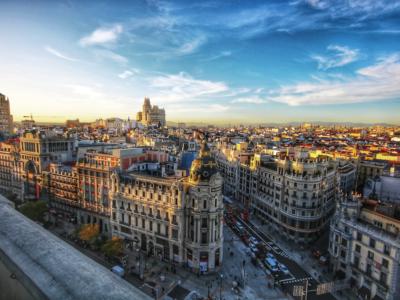
In sharp contrast to the rolling green mountains and quaint villages which make up the rest of Mallorca, its capital, Palma, is buzzing, trendy and chic. As well as El Corté Inglés, the city has a vast array of boutiques to suit anyone’s pocket, from Mango and Zara to Burberry and Carolina Herrera, and shoes by Pons Quintana and Jaime Miró. The old town has every description of bar and pub and its night-life rivals even that of high-season Magaluf. At night the streets are packed, (mostly with Spanish people) staggering from bodega to bodega. As Palma is a well-known mecca for celebs, you may even catch a glimpse of Catherine Zeta Jones and Michael Douglas on their yacht in Palma’s port on the west of the city.
Getting there Flights from mainland Spain are notoriously expensive, although can be cheaper at low season from Valencia or Barcelona. However, there are direct ferries from Dénia, Valencia or Barcelona. Contact Iscomar (Tel. 971 229 100), Baleària (Tel. 971 405 360), or Trasmediterránea (Tel. 971 702 300)
Where to stay Avoid hotels in the west of Palma on the waterfront – as well as being pricey, they are miles from the city’s action. 2-star hotels in Palma and surrounding areas start at 33 euros per night, although rustic, inland accommodation can be as much as 130 euros per night for bed and breakfast. The ‘touristy’ part is the east coast - if your cheapest option is a package resort, you can still enjoy the ‘real’ Mallorca - it is small enough to travel round in a car and there are regular bus routes from Palma to most towns on the island.
|