• Property for Sale
  • To Rent
  • Holidays
  • Directory
  • Articles
  • Jobs
    • € EUR
    • Professionals/Advertiser Login
    • Advertise your Property on thinkSPAIN
    • Sell your property with an estate agent
    • Add your Business to the Directory
    • Advertising with thinkSPAIN
    • List a job vacancy on thinkSPAIN
    • By Signing up you are agreeing with our Terms and Privacy Policy.

      Looking for the Professionals/Advertiser Login?
      or

      Don't have an account?  

      • Follow us:

By Signing up you are agreeing with our Terms and Privacy Policy.

Looking for the Professionals/Advertiser Login?
or

Don't have an account?  

Sign up

By Signing up you are agreeing with our Terms and Privacy Policy.
or

Already have a thinkSPAIN account?

Sign in/Register

By Signing up you are agreeing with our Terms and Privacy Policy.
or

Don't have an account?

Forgot your password?

thinkSPAIN Logo

El Hondo nature reserve centre


El Hondo nature reserve centre

thinkSPAIN Team 14/08/2003
El Hondo nature reserve centre
Although there are numerous road-signs directing you to the 'Parc Natural del Fondo' (confusingly, 'Fondo' is Valencian for 'Hondo') it may be as well if I talk you through it. The simplest way is to take directions for Catral, wherever you are approaching from. Just north of the town, on the way to Crevillente, there is a roundabout with motorway      (A-37) access. There you will see a sign for San Felipe de Neri, off to the east. Pass through that village, and, at about a kilometre, you come to a bridge. Turn right on an unmade road before you cross it, and you will arrive at the gates of the reserve centre. If you arrive at a 'civilised hour' in the morning (between 09.00 and 14.00 hrs on weekdays except Mondays, and later at weekends) you should find them open.
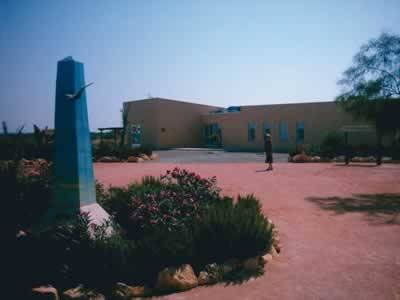
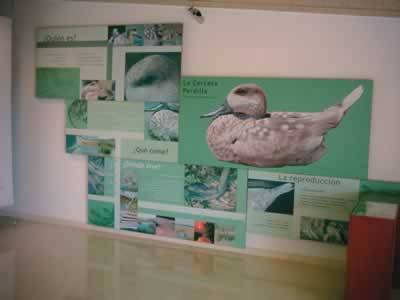
Enter and you come across a car-park that would do justice to a major football ground, with half-a-dozen cars parked in the corner. Cross a nice, landscaped bit of garden, and you have arrived at the splendid reserve centre, a purpose-built exhibition hall, equipped with the very latest in video technology, and some beautifully laid out displays, showing the work of the Medio Ambiente (Environment Agency) at El Hondo. There are impressive oversized mock-ups of Flamingos and the species for which the whole reserve has been established, the Marbled Duck.
The huge picture-window of the centre looks out over an area with permanent water – a local rarity in itself – and you can birdwatch here in air-conditioned splendour. The 'monitors' are currently fighting a battle with vegetation in this area, which they would like  to keep clear for waders, but one explained  that the area was cleared as recently as late spring, and the weeds are now waist-high. This same vegetation is more welcome in other parts of the
El Hondo nature reserve centre
reserve area overlooked by the centre, where extensive lakes have been provided, to attract Marbled Duck.
Formerly (and inaccurately) known as 'Marbled Teal,' these birds were at a very low ebb in Spain as recently as 1994, when the breeding population may have been as low as 30 pairs. A slow recovery, mirroring, though not so rapidly, that of White-headed Ducks, has taken place, aided by strict conservation measures, and the reserve of El Hondo has been home to a substantial proportion of the  country's population.
Most of these birds bred on the 'reserve proper,' where fluctuating water-levels and barely-controlled hunting did little to encourage growth. It was decided to establish this specific reserve, and a small but healthy breeding nucleus is becoming established. The current number of pairs is fifteen. During the breeding season they are, like many species, difficult to see, but as the young start to forage, in late summer and autumn, they start to appear in more accessible spots, and their lovely mottled plumage and piratical dark head-markings are a feature of the Alicante wetlands that many Northern European birders voyage long distances to see.
From the Centre, a nice boardwalk trail has been built. Whilst vegetation is still sparse, some species are absent, but it is possible to see a good range of birds in the area already. On my most recent visit, in the scorching heat of early August, a noisy Collared Pratincole passed
El Hondo nature reserve centre
over, seeing off a passing Marsh Harrier, and a party of six Wood Sandpipers 'chiff-chiffed' as they sprung up from a bank by the boardwalk. A little Ringed Plover flew off virtually from under my feet, and a Viperine Water Snake wriggled away as I headed back to the centre.
Back there, I spoke to two of the girls who work as monitors. At least two have a modicum of English, and all are unfailingly helpful and friendly. When conditions are right (in other words, when there is some water there) they can make prior arrangements for you to have a guided tour of El Hondo itself, some fi

Related Topics

  • Environment

Advertisement

  1. Spain
  2. Valencia region
  3. El Hondo nature reserve centre