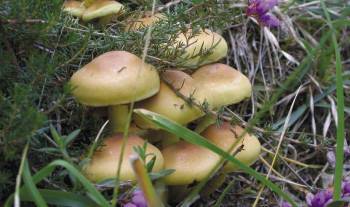
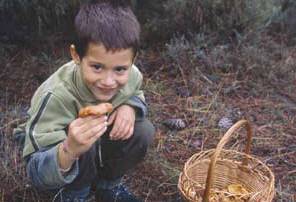
Mushrooms appear during other seasons of the year, including during the spring, but not in the abundance you can find them in autumn.
NOW is the perfect time to serve mushrooms freshly picked without having to resort to the dried, tinned or frozen variety. The further we go from industrial areas, the richer and more varied is the natural environment. The same can be said for the mercurial mushroom. Scientists have counted between 1,500 and 2,000 species of fungi.
An adept mushroom hunter will come to know at least one to two hundred different mushrooms. Most of the species will be systematically rejected, as they do not need specific recognition because they will never be picked for consumption due to their toxic and lethal effects.
The cry of the primitivists is: “Industry? No thanks!”, and the so it is for the mushroom. Few fungi species have been adapted to industrialisation and mass production. Among the few mushrooms that can be cultivated is the button mushroom. However, on the whole the rest of the mushroom family wants nothing to do with the process of civilisation.
They spring up unpredictably when and where they want. Sometimes, several years pass and they do not sprout due to lack of rain or dew. Being temperamental, the mushroom will not grow if conditions are not perfect.
A Spanish hobby Interestingly, although mushroom gathering is a difficult and arduous task, not only physically, many Spaniards take this occupation very seriously indeed. There are a multitude of mycological societies, courses, forums, slide shows and mushroom hunting excursions for devotees to the fungi.
Diversity of species The diversity of the species on the Iberian Isles is obvious and astonishing. It is in Cataluña and the Basque Country that mushroom picking is at its most popular. In these provinces the mushrooms’ greatest fans in recognition, hunting and consumption of the species can be found.
Throughout other provinces, mushroom collecting plateaus to a normal level and relatively few species are gathered and consumed. Notable is the fact that the boletus edulis, commonly known as porcini, has made a huge comeback in recent years and is one of the most hunted of the mushroom species.
The most common to be spotted, however, are the rovellón or the níscalo mushrooms. The bibliography dedicated to mycology and the study of specific region’s mushroom species is too extensive to give credit to here.
However, Llorenç Torrado has published Cocinar con Setas (Cooking with Mushrooms) and has an excellent mushroom stall in the Mercat de la Boqueria in Barcelona.
A game to be played Personally, I must admit that I have managed to collect very few mushrooms in my lifetime, most likely due to the fact that I do not possess one ounce of the kind of traditional mycological knowledge that was once so freely passed from father to son.
However, the few that I have managed to hunt down on my mushroom picking excursions have helped me understand the fascination the mushroom gathering connoisseur must experience. To many, mushroom hunting is like a game of hide-and-seek.
Mushrooms such as, the níscalos or rovellones, (or at least the only ones I dare to pick) tend to camouflage themselves. Believing you have just spotted dinner in fact, turns out simply to be a pitted stone or a leaf impregnated with autumnal hues.
But it is a healthy pastime (long walks), and enchanting too (autumnal forests have an attraction unsurpassed during any other season of the year). And while enjoying the stimulus of a mycological hunt, you feel an additional glow of achievement and pride when you actually find one.
Cooking mushrooms As a natural and non-industrial product, mushrooms require little culinary input. Some species are perfect for ac