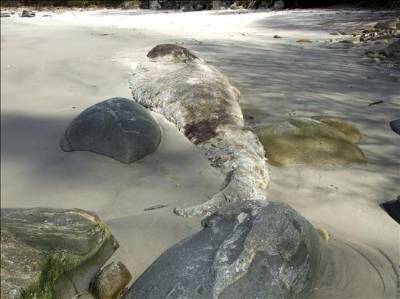
Members of the Galician Natural History Society (SGHN) in Ferrol have found the body of a six-metre long cetacean weighing in the region of 600kg washed up on the shores of a beach in A Coviña, which they believed died after swallowing a rubber gardening glove that blocked its digestive system.
The specimen found is a Cuvier's Beaked Whale (Ziphius cavirostris) an animal "about which scientists know very little" and which lives between the Cantabrian Sea and the Atlantic Ocean at depths of over 2000 metres. It is known to feed on large cephalopod molluscs which it hunts thanks to ecolocation, its special sonar which enables it to detect vibrations, since there is no natural light in its habitat.
Another common name for the species is Goose-beaked Whale on account of the fact that its head is said to be shaped like the beak of a goose. During the Middle Ages, this animal was thought to be a monster with a fish's body and an owl's head. Georges Cuvier first described it in 1823 from part of a skull found in France in 1804.
Ecologists have used the find to highlight once again "the number of cetaceans that are dying because they swallow plastic bags and other human rubbish" and insisted on the necessity to keep the oceans clean and to stop using the sea as a "rubbish tip".
The whale's body is in an advanced state of decomposition, but the skull will now go to form part of the exhibition at Ferrol's soon-to-be-opened Museum of Nature, which will house the biggest collection of cateacean skeletons in Spain.