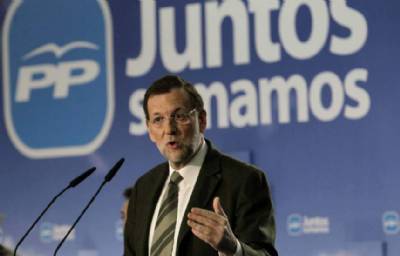
Prime minister Mariano Rajoy insisted today that "there will be economic growth in 2014 in Spain".
In an interview with Cadena Cope, Rajoy said he firmly believes that 2013 will be better than 2012 and that in 2014 there will be economic growth, based on the fact that the economy has fallen less than expected this year and fewer jobs will be lost than had initially been estimated.
Rajoy said he understood people's discontentment with the high levels of unemployment and the effect on domestic economies of the government's decisions, like tax increases, and said he'd like to be able to "reverse the situation, at some point in the future" with respect to some of the measures taken to correct the deficit.
"We would like to be able to lower income tax in 2014," he said. "I hope to be able to do so".
The Prime minister confirmed that he had no intention of increasing taxes any further in 2013 and that he would not lower civil servants' salaries either. However, he said he had not yet taken a decision with regard to pensions, and is waiting for the CPI results in November, on which pensions are usually calculated.
Rajoy also mentioned his dislike for the "euro per prescription" measure adopted in Catalonia and Madrid, saying that it failed to treat people "equally" and made people in those areas "pay twice" for their medication. He said he intended to negotiate this measure with the authorities in Catalonia and Madrid, but that if he did not reach a satisfactory conclusion, was prepared to take the matter to the Constitutional Court.
When asked about whether Spain was going to ask for a bail-out from the EU, Rajoy said he had not ruled out the possibility, but that he would make the decision "if and when it is in the general interests of all Spanish people".
With regard to the recent spate of repossessions, the prime minister accepted that the code of practice introduced in March "has not worked as we would have liked it to" and that new measures "to be applied immediately" are currently being negotiated with the PSOE to solve the "dramas, which are causing a lot of pain and are a very graphic image of the crisis".
With regard to the Hallowe'en tragedy at the Madrid Arena, which left four young girls dead, he said: "It is not a matter of modifying the law, but rather of ensuring that the current laws are adhered to".