A RADICAL reform of the education system in Spain has sparked criticism from several regional governments, particularly those with second languages.
Minister José Ignacio Wert wants to ensure that all parents who wish their children to be taught in Castilian Spanish have the facility available, meaning that where there are only places or schools for these pupils which teach the entire curriculum in the regional language – valenciano, catalán, gallego or the Basque language, for example – the autonomous government must pay for the child in question to attend a private school which offers education in Spanish.
This in particular has outraged the regional government of Catalunya, and massive protest have been organised over what many people consider to be an attack on their vernacular.
Other main changes include 50 per cent of schooling hours to be spent on core subjects, the minimum time spent on these and the content determined by the central government, as well as the maximum number of hours on 'specific' subjects.
Core subjects include Spanish and one foreign language, whereas regional tongues will be 'specialist' topic, albeit obligatory for the regions in question.
Children will be given formal, individual assessments at given points throughout their school career, and will start planning for either their bachillerato (Spain's answer to A-levels) or equivalent professional qualifications from age 14.
Pupils can choose between either religious studies or an alternative subject relating to teaching 'social values', both as obligatory specialist topics, although these will not be counted where subject failures mean a student has to repeat a year or retake an exam.
The reform covers the maximum number of times a pupil can do either, and how many subjects they have to pass without needing to resit a whole school year.
They will be able to go on to the next year if they fail up to two exams – in exceptional circumstances, three – but will have to resit them both when they go up a class in the autumn.
Bachillerato subjects will mutiply – in the past, students could opt for either the humanities or the sciences route, taking between 10 and 12 compulsory subjects, but now they can also opt for the social sciences or the arts routes.
Instead of having to take the Selectividad exam to get into university after finishing their Bachillerato, they will need to take a final test in order to obtain the title of the latter, which their place at university will depend upon – although each college may give extra preference to further or alternative qualifications, or additional tests.
Headteachers must have been actual teachers for a minimum of five years and have taken a compulsory additional training course.
Funding will be maintained for all-girl and all-boy schools, provided there is no evidence of discrimination.
Among some of the autonomous communities, Wert's educational reform has proven to be very unpopular, but he insists that it will go ahead 'with or without consensus'.
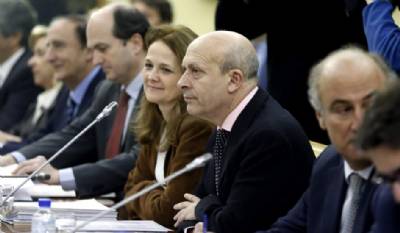
Photograph: Education minister José Ignacio Wert (centre) with MPs from various autonomous regions, presenting his planned schools reform