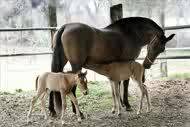
Spanish thoroughbred mare gives birth to healthy twin foals
Spanish thoroughbred mare gives birth to healthy twin foals
A STUD farm in Palencia has had twin filly foals born to one of its mares – a one-in-a-million occurrence and the first time the owner has seen this in 40 years.
The Palomar Redondo Stud, which breeds Pura Raza Españolas – Spanish thoroughbreds – has been in the hands of Jesús Pizarro since the early 1970s and this is a first for the yard, says the surprised owner.
Mares only ever conceive and give birth to one foal at a time after a gestation period of 11 months, which will feed off her until it is weaned at around four months old, or up to six if the baby is very frail.
About one in a hundred mares conceive two or even three foals at once, but if more than one foetus is detected during a scan, it will be removed instantly because of the risk to both the mother and babies.
If a mare proceeds to give birth to twins or triplets without miscarrying – the usual scenario – at least one and usually all the foals will die either within hours of birth, or they will be stillborn.
The mare also runs a high risk of dying in childbirth.
But in the case of this breeder from the central-north Castilla y León region, the mother and her twin daughters are doing fine and in perfect health.
This is about as likely as a human female giving birth to healthy octuplets and all of them surviving – in fact, even more rare.
“We had to bottle-feed one of the fillies for the first 24 hours, because she was very weak, but now she is much stronger and her mother is able to feed her,” explains Pizarro.
“And we really didn't believe she would survive, but even if she didn't, if the mother and the other foal both lived, this in itself would have been a near-miracle.
“They were born on Sunday morning – a week ago – and the first 24 hours are critical. Each day that passes, the risk of the mare or the foals passing away reduces, and now the twins are a week old and in good health, there is every chance they will be absolutely fine. They're already trotting and cantering round the field together.
“This is something I've never seen in my life, nor have any of my friends in the same industry,” Pizarro concludes.
The mare, Galatea, has a tale of her own to tell – she was sold when Pizarro's father-in-law, Jesús Hervella, decided to give up the stud, but seven years later, Pizarro saw the mare up for sale again and decided to buy her and re-start the stud farm with its 'original blood'.
A dark brown Pura Raza, one of her foals is the same colour and the other is bay, although over the course of the next few months they could change shade slightly.
The father, also a Pura Raza, is a chestnut stallion from a nearby yard.
Pizarro says the twin fillies have not yet been given names, but that both of these will start with D, since Galatea's babies are all named in alphabetical order and the foal she had last year, a colt, is called Carrión.