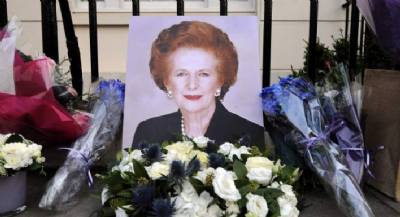
A STREET in Madrid is to be named after the late UK Prime Minister Margaret Thatcher, along with two others dedicated to Hollywood diva Sara Montiel and Nobel Prize writer José Luis Sampedro.
Only the PP has voted in favour of adding the British Conservative leader to the long list of celebrated figureheads who have roads bearing their name in the capital, including French medic Marie Curie who discovered radiotherapy, Indian peace activist Gandhi, Olof Palme, Sandro Pertini, Marcelino Camacho, and Rosa Luxemburgo.
Spokeswoman for United Left, Milagros Hernández, said Thatcher, who passed away following a stroke on Monday, April 8, left 'thousands of people poor' after 11 years at the helm, and was responsible for 'economic and welfare cutbacks' that spelt disaster for families across the UK.
Hernández said her real admiration was for the English miners and union members and leaders who suffered during Thatcher's reign.
Otherwise, the parties which voted against the Iron Lady being immortalised in the Spanish city, or abstained, justified their views by saying she had no connections with Madrid.
But in the autumn of 2010, 'Maggie' was awarded the second Freedom Prize by the FAES Foundation, presided by ex-Spanish president José María Aznar (PP), the only previous award of this type having been presented to King Juan Carlos.
At the time, Aznar spoke of Baroness Thatcher as being an 'historical personality' whose lifelong career in politics 'reflected the objectives' of the award.
The Freedom Prize was launched to reflect similar initiatives in the UK and USA to reward and recognise outstanding work by public figures in the fight for democracy and liberty.
Thatcher's legacy and 11-year stint as the UK's first – and to date, only – female Prime Minister, having started out as Conservative MP for the London Borough of Finchley in 1959 and gone on to become Education Secretary were described as having an 'undeniable historical impact', particularly concerning her role in breaking down the iron curtain, the fall of the Berlin Wall and the end of political repression in the former USSR, on the same level as her US contemporary Ronald Reagan and also Helmut Kohl and Pope John Paul II, who died on April 2, 2005.
Loved and hated in life and now in death in equal measures, Margaret Hilda Thatcher, née Roberts, was responsible for thwarting an Argentine invasion of the Falkland Islands, which the Latin American occupants still refer to, to this day, as Las Islas Malvinas.
She fell foul of the working public when she shut the mines in the north of England, privatised public-sector firms and eradicated most of the power held by trade unions, and the end of her reign was blighted by the poll tax riots, unemployment at three million and interest rates at 15 per cent, which led to thousands of home repossessions across Britain.
But a freedom fighter who encouraged people to argue with her as heatedly as possible, who was determined Northern Ireland would form part of Britain and who stuck to her guns even when those around her disagreed with her policies, the Baroness Thatcher – who met Aznar three years ago to accept her Freedom Prize – has been lauded even by her adversaries as a woman with a mission who was determined to shake up the country she led between 1979 and 1990.
Plans to name streets after Sampedro, described as 'a literary Gandhi', and Montiel, whose 50-year Tinseltown career put Spanish cinema on the map, did not even need to be put to the vote because everyone present was already in favour.