Spanish explorers find three-million-year-old Martian meteorite in Tunisian desert
Spanish explorers find three-million-year-old Martian meteorite in Tunisian desert
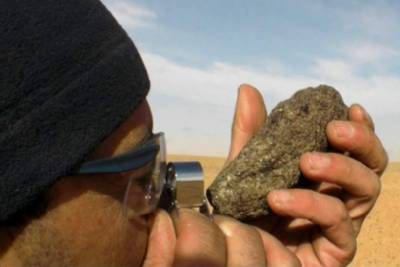
A METEORITE found in the Tunisian Sahara desert by two Spaniards has turned out to be a lump of Martian rock.
It was discovered in 2010 but the finding has been kept secret until now as researchers at Catalunya Polytechnic studied it.
According to head of the Faculty of Nano-engineering, Jordi Llorca, the composition of the meteorite – which weighs just over half a kilo – is identical to that of two other rocks found in Morocco and in Los Ángeles (USA) which form part of meteor shower which permanently orbits Mars.
The meteor shower originated through a collision by an asteroid against Mars some three million years ago, and it frequently travels close to the Earth.
Its origin is the deepest yet in the Martian crust, and is a KG-002, of the Shergottita type, which is the 17th most significant of all interplanetary rocks found.
Physics graduate David Allepuz, from Corbera de Llobregat (Barcelona province) who works for La Caixa bank and geologist José Vicente Casado, who owns a mineral shop in León, search for meteorites as a hobby and found this one in the Sahara desert in Tunisia.
When they gave it to Llorca for analysis, they were told not to say anything about their discovery, in the hope that other, similar rocks would turn up.
It is the only one of 57,000 meteorites found by Europeans outside the Antarctic and the sole space rock of which there is audio-visual footage of its discovery.
Of these 57,000 rocks, a total of 117 are from Mars, but this is the one found to have come from the deepest location in the surface of the planet and has revealed fascinating information about the atmospheric and geological makeup of this other world.
It shows that 120 million years ago, Mars' centre became solid rather than boiling liquid and had a dense atmosphere.
Llorca believes the meteorite is the result of 'the greatest cosmic catastrophe' in the history of the solar system.
Allepuz and Casado, authors of the book Meteorites: Introduction and guide to recognition, have carried out six international space-rock search expeditions and recovered 16 meteorites, most of which have come from asteroids.
The Ksar Ghillane area of southern Tunisia is recognised as an 'Area of Concentrated Meteorite Collection', of which there are only 40 in the world.
Even so, one meteorite per square kilometre falls every 10,000 years and only one in 10,000 come from Mars, which means finding a Martian rock 'is like winning the lottery', Casado and Allepuz explain.
They recommend searching in deserts, particularly those with white sand, since black rocks show up better – and most meteorites are black because they burn as they pass through the Earth's atmosphere, the two authors explain.