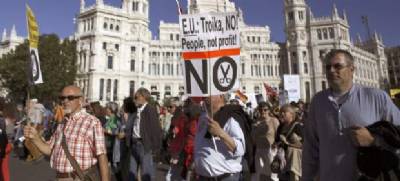
Anti-Troika demonstration in 80 European cities includes 11 in Spain
Anti-Troika demonstration in 80 European cities includes 11 in Spain
HUNDREDS of thousands of people joined in a protest march in 80 European cities yesterday (Saturday) evening against the 'catastrophic policies' of the Troika.
Madrid hosted the largest demonstration on the continent, with several thousand people setting off from the Plaza de Neptuno at 18.30hrs.
The international call-up for protesters said the Troika – made up of the Central European Bank (BCE), the International Monetary Fund (FMI) and the European Commission (EC) – had, through its economic and financial decisions, caused 'poverty, home repossessions, hunger, cutbacks, labour reforms and privatisation'.
Their banners read 'we don't owe, so we're not paying' and 'Rescatan al banquero, desahucian al obrero', which translates as 'they rescue the banks and then repossess the workers' homes'.
As they passed the national PP headquarters, they called for president Mariano Rajoy to resign.
Europe has demanded Spain increases taxes even more and puts up IVA beyond its current 21 per cent, makes cuts in pensions and in the minimum wage – but Rajoy says he does not intend to do this.
And although he says he will 'take on board' the Bank of Spain's recommendations that the long-term unemployed should be taken on in full-time, 40-hour-a-week jobs at less than the current minimum wage of 645 euros, and that State retirement age should be increased to 67 immediately, Rajoy insists the government will stick to its existing plans.
Leader of SIRYZA, the Radical Left Coalition in Greece, Alexis Tsipras, and João Camargo, head of the Portuguese pressure group Que se lixe a Troika (literally, more or less 'throw the Troika in the bin', but in the sense of 'may the Troika fail') joined the protest in Madrid as did leader of Izquierda Unida ('United Left') at national government level, Cayo Lara.
The anti-Troika march in Frankfurt, Germany's financial capital, organised by pressure group Blockupy, involved violent confrontations between police and a small group of demonstrators, and several towns and cities in Portugal – including the capital, Lisboa – a country where the unemployment figure of 18 per cent is the highest in living memory also joined the Europe-wide protest.
Back in Spain, Valencia, Barcelona and Zaragoza staged demonstrations, as did A Coruña, Vigo, Lugo, Ourense and Santiago de Compostela in Galicia, and Vitoria and San Sebastián in the Basque Country.
Protests took place elsewhere in Europe – in Brussels, outside the BCE, in France, The Netherlands, Italy, Hungary, Slovakia, the Czech Republic, Croatia, Austria, England and Northern Ireland.