Spain is 23rd out of 60 countries for proficiency in English
Spain is 23rd out of 60 countries for proficiency in English
HOLIDAYMAKERS and expatriates in Spain who assume 'everyone will speak English' had better put their names down for a Spanish language course – the country ranks 23rd out of 60 for its linguistic abilities in Shakespeare's tongue.
Whilst Sweden and Norway came out top of the list for having highest portion of citizens who speak English competently, Spain did not fare so well in the research carried out by EF Education First.
The results of their third English Proficiency Index showed Asians are becoming more fluent, with far weaker levels of the language in Latin America and the Middle East.
A direct relationship between the health of the economy and levels of investment in social programmes, and abilities in English, was found.
Researchers based their results on a random sample of 750,000 adults in 60 countries worldwide in 2012, and five million in the same 60 countries over the six-year period comprising 2007 to 2012 inclusive.
Vietnam and Indonesia are two Asian countries which have 'transformed' their linguistic competence in English since 2007, China has improved greatly although not to such a noticeable extent as the other two nations, and Russia has overtaken China.
Japan and South Korea, despite considerable private investment in education, have seen their levels of proficiency decline slightly.
India, where English is one of the official national languages and spoken fluently by all workers and anyone who has been to school, as well as being used as a lingua franca when travelling to other regions which have different tongues – natives of the northern Hindi-speaking region visiting the southern Tamil-speaking territories, for example – remains among the highest on the list, and Brazil is fast catching up with Asian countries.
The seven European countries with the best English are smaller nations with tongues that are barely spoken elsewhere in the world, on the whole, according to the survey – but France does not have a much better record than Spain.
Other than the United Arab Emirates (UAE), of which Abu Dhabi is the capital and Dubai a global and cosmopolitan city, North Africa and the Middle East have very poor levels of English, but border country Turkey has shown the greatest improvement of all 60 over the last six years.
Latin American nations fill up the bottom of the list – although Brazil, Perú, Colombia and Chile have improved, in the case of all bar Brazil this is very slight and barely noticeable and certain countries in the region, including México and Guatemala, have seen a considerable decline in their national English proficiency.
Is English really taking over the world – and where does that leave Spanish?
Spanish continues to have considerably more native speakers worldwide than English – 406 million compared to 335 million – and both are beaten by Mandarin Chinese, which remains at the top of the list with 848 million native speakers.
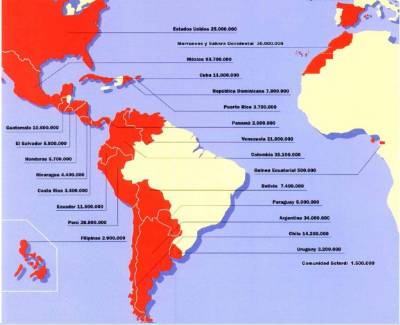
In terms of distribution, Spanish comes second, being the official native language in 19 Latin American and Caribbean countries, plus Spain, and unofficially in The Philippines, Equatorial Guinea, Western Sahara and Morocco, where it coexists with other, main and more dominant languages – a total of 24 worldwide, plus the Sephardic Jewish communities in Israel and the Persian Gulf.
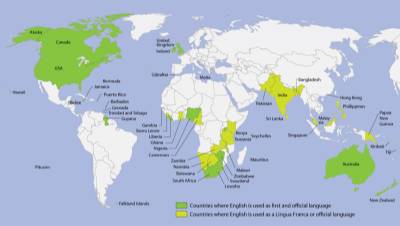
English is an official native language – even where not the first or dominant tongue – in over 40 countries, notably the UK and Republic of Ireland, the USA and Canada (except for Québéc), Australia and New Zealand.
Elsewhere in Europe English is the official language of Gibraltar and one of the two native languages of Malta, as it is in the African countries of Nigeria, South Africa, Lesotho, Botswana, Malawi, Kenya, Swaziland, Zimbabwe, Zambia, Namibia, Liberia, Ghana, Sierra Leone, Tanzania, The Gambia, and The Seychelles.
In Oceania and the South Pacific, other than in Australia and New Zealand, English is the native language of the islands of Fiji, Pitcairn and Kiribati, and of Papua New Guinea.
Caribbean and American mainland countries besides the USA – including Hawaii – and Canada are Jamaica, Grenada, Trinidad & Tobago, Bermuda, Barbados, The Bahamas, Belize – formerly British Hondurás – and Guyana.
South Asian countries with English as the sole, or one of the official native tongues include the Chinese island of Hong Kong, a former British colony, plus Malaysia, Thailand, Singapore, Sri Lanka, India, Pakistan and Bangladesh.
However, in terms of the total number of speakers worldwide, including non-natives, English then becomes number two on the list with 765 million, above Spanish at 568 million and below Mandarin Chinese at 1.2 billion.
In fact, English and French are the only two languages currently on record where the number of non-native speakers exceeds that of natives, although Russia is fast catching up with 162 million native speakers and 115 million who speak it as a foreign language.
In all calculations, whether including or excluding non-native speakers and in terms of both number and distribution, the top three languages in the world are followed by Hindi, Arabic, and then Portuguese.
Sources of this information include the Swedish national encyclopaedia of 2010, a report from the Cervantes Institute in Spain of 2013, and up to date reports on krysstal.com and ethnologue.com.