PP second-in-command 'accidentally' votes to oust Wert as education reform gets final 'Royal assent'
PP second-in-command 'accidentally' votes to oust Wert as education reform gets final 'Royal assent'
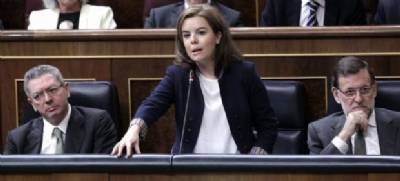
GOVERNMENT vice-president Soraya Sáenz de Santamaría has voted for education minister José Ignacio Wert to cease his management role of the department – by mistake.
The socialists tabled a motion to censure Wert's schools reform and take him out of the hotseat at the head of the ministry, which was supported by votes in favour from CiU, Izquierda Plural, PNV, the Catalunya-based left-wing republicans ERC, and BNG – as well as the vice-president of the PP.
She realised her mistake immediately, but it was too late as her vote was binding. UPyD (Union, Progress and Democracy) and the Foro de Asturias abstained, but the votes against by the UPN and the PP government were enough to constitute a majority and see the motion binned – even with Sáenz de Santamaría's having accidentally voted in favour. As a result, the unpopular education reform has gone through and been given the seal of approval in Congress, a decision which is set to inflame the school and university communities across the country.
Among the aspects of the reform which have been most criticised are plans to deny tuition fee grants to university students who do not achieve 55 per cent in their blanket entrance exam, or Selectividad, even though the pass mark is 50 per cent and reaching this grade means they have not failed and cannot therefore retake the test – and refusing grants towards living costs to anyone whose Selectividad results do not amount to 65 per cent, the equivalent of a C or C+ grade.
The final grade is entirely exam-based with no coursework being taken into account, meaning a student having a bad day when they take the final test could scupper their college career forever unless they or their parents can afford to finance it in full. Ongoing grants throughout university – for undergraduate or postgraduate degrees, including master's and PhD qualifications – are dependent upon achieving a certain grade or passing a given percentage of modules throughout the year.
Already, students in Madrid who did not reach the required standards are being ordered to pay back their grants for the year – sums ranging from 500 to 1,000 euros, which have already been spent and which they did not envisage having to refund, meaning they are unprepared for the sudden demand for cash.
Wert says this move is to ensure the State only finances those who are serious about their higher education and who are in fact capable of pursuing one, rather than throwing away money on those who decide to drop out midway through.
Grant refunds in Madrid have also been ordered for students of Bachillerato (Spain's answer to A-levels) and FP, or the vocational equivalent of sixth-form education (similar to BTEC qualifications in the UK).
One teacher says he has two pupils facing huge bills – one of whom has been forced to cease his studies for the year because his father is terminally ill, and another who has to move to the other end of the country because his family is relocating.
Whilst tutors say some cases may be justified, they are calling for authorities to look at each case on an individual basis.
Teachers, students and parents also complain the new education law, the LOMCE, effectively weeds out less-bright pupils, whilst at the same time failing to allow the more gifted to realise their full potential.
Wert has also announced plans for pupils whose parents want their children taught in Castilian Spanish rather than the regional language spoken where they live to be given the option to send them to a private school to achieve this, at the cost of the State – a move which has not gone down well in autonomous regions such as Valencia, Catalunya, Galicia, the Basque Country and the Balearic Islands.
Certain teachers and parents feel Wert should not be providing funding to single-sex schools, calling it 'segregation', and his stance on religious education (RE) has fallen foul of both those who have brought their children up in a secular environment and also the Catholic Church.