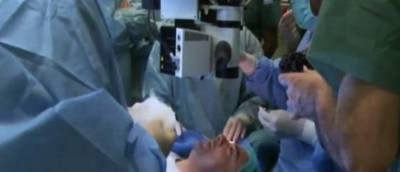
Granada medics implant artificial cornea containing human cells for the first time
Granada medics implant artificial cornea containing human cells for the first time
TWO hospitals in Granada have implanted an artificial cornea for the first time ever during a clinical trial on a 51-year-old man with a serious eye complaint.
Specialists from the San Cecilio and Virgen de las Nieves hospitals say the implant contains two types of different human cells and a bio-material based upon nano-technology.
The patient, José Luis, suffered a corneal fibrosis which meant he was only able to see light, not colours or objects – a condition for which there is no other cure or effective treatment at present.
Nine surgeons, led by ophthalmologists Dr Miguel González Andrades and Dr Santiago Medialdea operated on José Luis last week and, just two days after the procedure, he was already said to be experiencing relief from the pain and irritation he had been suffering in his eye as a result of his condition.
He will need to go for check-ups on a regular basis for the next two years.
One of 20 patients with serious corneal ulcers or opaque cornea were involved in the clinical trial, of whom five were initially picked out for the artificial implant, and the first of whom was José Luis.
Each one will be monitored for six weeks before the next person is operated on and, once their progress has been closely studied and deemed acceptable, the other 15 candidates on the trial will undergo the same procedure.
Five of them will have an artificial cornea and the rest will have a transplant of an amniotic membrane, which is a more conventional method of treating serious corneal ulcers.
Dr González Andrades says it is 'very unlikely' they will be able to cure blindness, but that the technique helps alleviate pain and irritation and improve sight to a certain extent.
The clinical trials are attempting to ascertain whether participants are likely to recover their sight in full, although it is still too early to tell and the first step is to monitor whether the procedure is in fact safe, Dr González Andrades explains. Dr Santiago Medialdea says the technique, in which six public hospitals in Andalucía are taking part, is 'a scientific hit'.
The artificial cornea was designed by the Faculty of Histology at Granada University after studying the features of this type of cornea in an animal used as a 'model'.
They have been working on it for three years with the aim of its being manufactured in bulk at the Cellular Production Unit of the Virgen de las Nieves hospital and the Transfusion Medicine Centre of Granada and Almería, and that it complied with the rigorous standards required for it to be implanted into human patients.
Until now, the only advances made in this area have been implanting a collagen-based cornea – carried out by a team of Swedish doctors – and one made of an amniotic membrane, meaning the one developed in Granada using two types of human cell is a pioneering technique.
Andalucía's regional health authority has pledged to invest 66 million euros in scientific research and development this year.