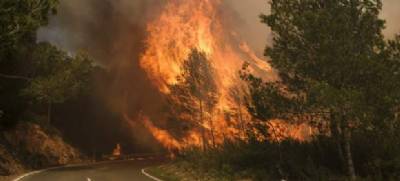
Forest fires 'could be thwarted 20 years before they break out', says WWF
Forest fires 'could be thwarted 20 years before they break out', says WWF
FOREST fires could be prevented 20 years ahead of their happening if the government would invest sufficient funds, says Spain's branch of the World Wildlife Fund (WWF).
Effectively, a fire which breaks out this summer could have been avoided with proper planning in 1994, the leading environmental charity claims.
Every year, an average of 15,600 wildfires break out – mostly in summer – of which 28 are raging infernos wiping out massive areas of land and threatening the safety of property and people.
And 40 per cent of the serious damage to the countryside is caused by just 0.2 per cent of them, each causing considerable damage to the environment.
Governments spend 51 million euros annually on extinguishing forest fires, 18 million on preventing them and just 10 million on regenerating damaged areas – and yet the latter two are the most crucial, the WWF states.
The problem here is that politicians consider fire prevention an 'expense' rather than an 'investment', says secretary-general of the WWF, Juan Carlos del Olmo.
Regenerating fire-damaged areas can take up to 30 years but, done properly, can actually prevent a blaze taking hold in the future, says Lourdes Hernández of the charity's forestry team.
Most fires which cause major destruction happen in areas where 'invasive' species of plants or trees are grouped together, particularly where there are only one or two types at a time.
By choosing an 'irregular' mix of native trees and plants – a minimum of 65 per cent, and only occupying 23 per cent of the fire-damaged area, the risk is cut, as is the 'pattern' in which they are planted.
Sra Hernández explains that by planting trees in a mosaic pattern with more open forestry masses, a diverse selection of hardy and fast-growing species and strategically-placed shrubs forming a fire-break, a blaze is less likely to break out and, if it does, will be far easier to contain and less likely to spread and cause havoc.
Sr Del Olmo says 'ineffective' regeneration exercises showing 'lack of planning, evaluation or follow-ups', and without the necessary expert scientific knowledge, the result is at best useless and can actually leave the areas vulnerable to future fires.
Forest fires hit the headlines almost daily in the summer in Spain due to the dry landscape and withering plant-life, combined with intense heat, especially in the east, south and centre of the country.
The blots they leave on the landscape are at best unattractive, and in fact could have much more far-reaching effects than merely visual impact.
Destruction of greenery – especially trees – means less of the harmful pollutant carbon dioxide is soaked up and eliminated from the atmosphere, and less oxygen generated.
Not only does an excess of carbon dioxide and a reduction in photosynthesis, where trees absorb humidity and 'sweat' it off to create clouds and rain, mean climate change could have devastating effects within the lifetimes of today's young adults, but a decline in oxygen production could be literally fatal to human life.
The Amazon rainforest produces 70 per cent of the world's oxygen, a fact which illustrates the importance of trees and plants to human survival.
And Greenpeace has already predicted that if the sea-levels continue to rise at the current rate, within 50 years the entire beaches and promenades of holiday hotspots such as Cullera (Valencia), Benidorm (Alicante) and Málaga could disappear under water.