Strict controls in place at Spain-Morocco border amid Ebola scare
Strict controls in place at Spain-Morocco border amid Ebola scare
SPAIN'S government has upped vigilance at the borders of Ceuta and Melilla in light of the Ebola pandemic and applied strict procedures to protect Guardia Civil officers stationed at the frontier.
A regular point of entry for would-be illegal migrants from sub-Saharan Africa who storm the chain-link fences in their hundreds almost nightly, the Spanish-owned city-provinces of Ceuta and Melilla on the northern Moroccan coast means patients affected with the deadly haemorrhagic virus may slip through the net.
Once in either city, they are on Spanish territory and can reach the mainland or islands without needing a passport or going through customs, since it is effectively a trip to another part of the same country.
The immigration centres in both enclaves, overrun with Africans trying to enter Europe via the back door and living in borderline inhumane conditions due to overcrowding, could also be a hotbed of Ebola if any of the inmates have come from an affected country.
Workers at the centres and at the Spanish border with Morocco are now considered 'exceptionally high-risk' and the Federal Police Union has complained that no emergency procedures have been taken for their protection.
This has stirred the government into action, and vigilance already in place at airports has been extended to immigration centres and to the Moroccan border.
But the head of the border police, Emilio Baos, has insisted there is no cause for alarm as yet.
Everyone taken to the immigration centres in Ceuta and Melilla is given a thorough medical check-up and, given the heightened risk of tropical diseases from the central sub-Saharan strip of Africa, are automatically placed in isolation at the first sign of any suspicious symptoms.
Repatriated priest 'recovering well'
The controversial repatriation of Brother Miguel Pajares, 75, from Liberia – dubbed by Spanish medics as a 'political, not health-related' decision – has gone well and the patient is said to be responding well to treatment at Madrid's Carlos III hospital.
A medically-qualified missionary from a religious order who had been posted to Liberia to treat patients affected with Ebola in light of the lack of doctors available in the west African nation – some have died, including the director of the hospital in the capital, Monrovia, or become infected, and others have left their jobs in fear – Miguel Pajares has been diagnosed with the disease and kept in quarantine in Liberia.
His condition was described as 'very serious', as he was exhausted, delirious, unaware of what was going on around him, unable to eat and with a fever of 39ºC.
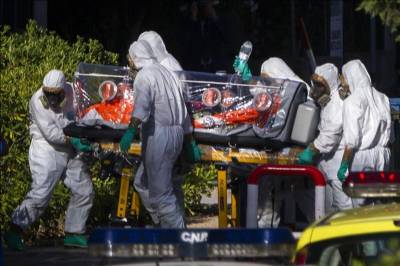
The missionary was repatriated in a military aircraft inside a sealed plastic 'box' with oxygen and treatment supplied through it, in order that he should not breathe the same air as anyone else, and specialist medics robed from head to foot who were bodily disinfected afterwards transported him to an isolation ward.
Hospital sources say he is expected to make a full recovery within around two weeks, despite having been at death's door and facing certain doom if left behind in Liberia.
Doctors treating Pajares say there is no real risk of infection from the patient.
On a separate plane, missionary Sister Juliana was also repatriated from the same Liberia hospital – a Guinean woman who holds Spanish citizenship, she was brought to Madrid as a precaution, even though she has not been displaying symptoms of Ebola.
She is said to be in good health but will remain under observation until the incubation period passes.
Initial reports that the religious charity Juan Ciudad ONGD would have to pay the costs of Miguel Pajares' repatriation have been denied by Spanish president Mariano Rajoy, who considers it 'logical' that the State should fund all treatment including flying the missionary home.
Terrified missionaries working in Liberia - Sister Paciencia, from the former Spanish colony of Equatorial Guinea, Sister Chantal from the Democratic Republic of the Congo, and Sister Catherine, also said to be from a currently non-infected African nation – say they have seen no sign of their being repatriated and fear that their already-diagnosed Ebola will claim their lives.
Although Liberia has the expert knowledge to treat the disease, lack of equipment due to insufficient funding and a shortage of doctors mean anyone who remains there is in grave danger.
The Ebola virus, for which the survival rate is lower than 10 per cent, causes internal bleeding, kidney and liver failure within days, and according to the World Health Organisation (WHO) is out of control in Liberia, Sierra Leone and Guinea, and may have reached Nigeria.