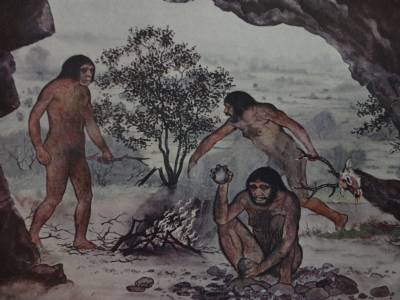
Modern Europeans descended from three prehistoric races, say Spanish researchers
Modern Europeans descended from three prehistoric races, say Spanish researchers
TODAY'S Europeans are a mix of genes from three populations of early humans, not two, according to a study jointly involving two Spanish universities.
The research, published in the magazine Nature, explains how it has always been assumed that modern-day Europeans are a combination of the hunter-gatherers and the earliest agricultural farmers.
But the Institute of Evolutive Biology at Barcelona's Pompeu Fabra University, together with researchers from the University of Santiago de Compostela in the north-western region of Galicia, have found that a third 'species' of human is included in the modern genetic makeup.
This is a race which as yet has not been named, but which extended across the north of Eurasia - what would now be the eastern Baltic states and Russia - arriving in central Europe later than the early land-farmers.
Agriculture and domestication of animals started in the Near East about 11,000 years ago, leading to sedentary land-farmers migrating across Europe and western Asia, eventually substituting the hunter-gatherer race.
Their population increased and they began to settle down, forming large cities and societies of varied and complex cultural features, says the paper.
Central Europe's earliest agricultural farming started around 7,500 years ago with the birth of the 'sedentary farming' culture known as the Linearbandkeramik (LBK).
Scientists are still debating whether these changes came about through mass migration of settlers from the Near East, who brought new techniques and technologies, and domestic animals, to Europe or whether it was a case of cultural practices that were inherited and adopted by neighbouring populations.
The gene distribution between indigenous hunter-gatherers and today's Europeans remains an unsolved mystery, although steps have been made towards solving it by a team of resarchers from Tubinga University in Germany, Harvard Medical School in the USA, Dr David Comas from the Pompeu Fabra's Evolutive Biology Institute and Dr Antonio Salas of Santiago de Compostela University.
They have studied thousands of genomes of ancient Europeans, sequenced the DNA of the first agricultural farmers - said to be from Stuttgart, Germany, around 7,000 years ago - as well as the hunter-gatherers from a refuge in Loschbour, Luxembourg, which are about 8,000 years old, and seven hunter-gatherers from Motala, Sweden, who were around about the same time as those from Luxembourg.
The scientists generated genomic data from 2,400 humans of 200 different modern-day populations around the world.
They have found that northern Europeans have more of the hunter-gatherer genes, whilst today's southern Europeans have more agricultural farmer genes.
The third race, from the north-east of Eurasia, is the smallest part of the mix - no more than 20% in the case of modern Europeans - but found in practically every DNA sequence studied for the continent as well as those from the Caucasian and Near East areas.
Perhaps most intriguingly, hunter-gatherers - whose genes are more present in the north of Europe today than in the south - tended to be blue-eyed and dark-skinned, whilst the early agricultural farmers, whose DNA is more often seen in modern southern Europeans including Spaniards, were pale-skinned with brown eyes.