Ebola update: Teresa 'conscious and talking to medical staff' and now 'stable', but still 'serious'
Ebola update: Teresa 'conscious and talking to medical staff' and now 'stable', but still 'serious'
Total of 17 people in isolation: doctors, nurses, paramedics, cleaners, and hairdressers
NURSE Teresa Romero, the first person to catch Ebola outside of Africa, is 'slightly better' after a touch-and-go night between late Thursday and the early hours of Friday when she was reported to be on a life support machine and her organs starting to fail.
By around 05.00hrs on Friday, reports claimed her situation was 'very critical' and her life in 'serious danger', but by 09.00hrs she was said to be 'serious but stable'.
It is believed the virus has been contained within her body and not spread, partly with the help of blood from Equatorial Guinea-born Spanish nun, Sister Paciencia, who survived Ebola with nothing but prayers and paracetamol to treat her as she was left to die in a 'pre-morgue ward' in a Liberia hospital.
ZMapp and a very similar drug, ZMAb, have been brought in and are also being used to treat Teresa.
She is now said to be conscious and 'talking to staff', although she is not out of the woods yet and although stable, is still said to be in a serious state.
Another 17 people have been admitted to isolation wards at the Carlos III hospital in Madrid, the country's only specialist unit for treating infectious and tropical diseases.
Some have attended voluntarily, including doctors and nurses who treated missionary doctor Manuel García Viejo, repatriated from Sierra Leone, who died in September.
Those who treated Miguel Pajares, another missionary doctor air-lifted home from Liberia, would not be at risk now since he died on August 11 and the incubation period is three weeks.
Ebola can only be passed on once the sufferer is showing symptoms, meaning that during the 21-day incubation period when the patient is apparently completely healthy, contact with him or her is safe.
But as soon as the first signs of the disease – normally fever, but quickly followed by fatigue, muscular pains, diarrhoea and vomiting – appear, any contact with even the smallest amount of bodily fluids can pass on the disease.
This includes the smallest amount of sweat, meaning shaking hands with an affected person can cause it to infect a third party.
Teresa says she does not know how she caught it, having attended to García Viejo twice – once to change his sheets and incontinence pad, and once to clean his room after his death – but can only speculate she may have touched her face with her gloves whilst removing her scrubs and overalls.
Teresa's husband Javier Limón will remain in isolation for at least three weeks, but tests cannot be carried out on him until he starts to show symptoms, as the virus would not show up.
A lady doctor from the health centre in Alcorcón, Madrid, where Teresa and Javier live and a male doctor from Alcorcón hospital, both of whom attended to her before she was diagnosed have been in isolation since Wednesday.
A doctor who attended to Teresa during her critical period on Thursday and a paramedic from the SUMMA ambulance service who dealt with her before she reached her local district hospital in Alcorcón are under observation, along with a female nurse who worked with Teresa caring for García Viejo.
The latter is awaiting the first test for the virus – normally, two are carried out.
Five women and two men were brought into the Carlos III on Thursday night – two hairdressers who did Teresa's hair during the week she believed she had a fever, two nurses, a doctor, a supervisory nurse and a hospital porter.
Last night, another woman who works at the salon where Teresa went for a haircut and a wax was admitted to the Carlos III, as was a female nurse from La Paz hospital, upon which the Carlos III depends, and a cleaning lady from Alcorcón hospital.
None of the above have shown any symptoms as yet.
Two nurses – a man and a woman – who treated García Viejo have been discharged after they passed the incubation period and tests showed up negative.
An engineer who had travelled over from Nigeria with a fever has been tested and now discharged in light of the negative results, and is thought to have contracted malaria rather than Ebola.
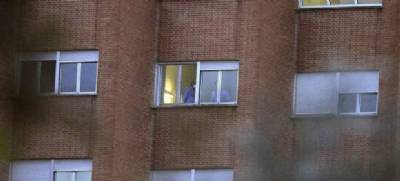
Photograph: Medics in Teresa's room at the Carlos III hospital