
Air travel's 'green' future: Why food-waste fuel is a long-haul project
Debate over banning short-distance flights takes off, but the cons outweigh the pros
Sign in/Register
Looking for the Professionals/Advertiser Login?
By Signing up you are agreeing with our Terms and Privacy Policy.Forgot your password?
Feedback is welcome

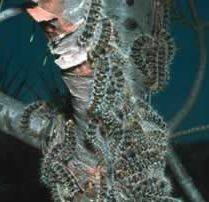
“By attempting to kill the caterpillars we actually made the situation worse”, explained Johm Emptage, who together with his wife Diane has had problems with large numbers of caterpillars.
The couple, who live in the Xaló valley, told us they had cut down branches containing the nests from the trees in their garden and burnt them.
But soon afterwards Diane discovered more than fifty processionary caterpillars climbing the outer wall of her house. Having already been affected by the venom of the caterpillars, Diane was horrified to see droves of caterpillars now trying to get into her house.
It seems that at the time the nests were cut down, many of the caterpillars were not in them, and when they returned and found the nests gone, they proceeded to search for somewhere else to go.
John and Diane were amazed by the distance that the caterpillars had marched, and the terrain they had crossed, in order to reach the wall of their house.
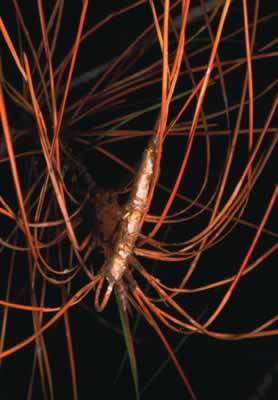
Diane described the pain of coming in contact with the caterpillars as “very itchy” and “sore… a bit like one of those exercise belts at the gym that wraps around you and vibrates!”
Regrettably, Diane had peered into the burning barrel of branches and caterpillar cocoons, she thinks that the poisonous hairs from the caterpillars were carried upwards with the smoke and subsequently into her face and neck. The following day Diane suffered not only from an itchy and sore inflammation on the palm of her hand but her neck was also red and painful. Even a few days later, a red blotch was still visible on the palm of her hand.
Diane recalls a few weeks ago, before the caterpillars were anywhere near their current size, that even tiny ones were finding their way into all kinds of strange places. “There was a baby one stuck on a pair of undies that had been hanging on the washing line!” Luckily Diane spotted it – the consequences, had she not seen it, don’t bare thinking about!
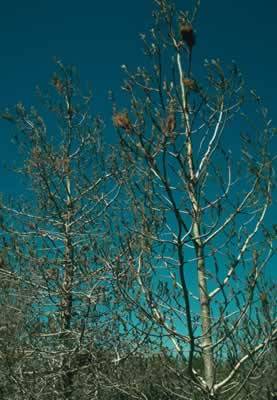
Diane and John spent quite a few days removing the caterpillars from the wall of their house with kitchen roll, and then setting fire to them. There are still some nests at the top of the trees, but Diane and John cannot reach them, and are worried that if they burn more nests another mass of caterpillars will process towards their house again.
Currently there are no more caterpillars on the walls of the house, but as Diane has both cats and a dog, she is worried about letting them out into the surrounding area in case they come into contact with the venomous hairs. She relays a story about a friend of a friend whose dog was so badly injured by the caterpillars he eventually had to have some of his jaw removed when it became infected.
If you have a problem with processional caterpillars you can call the ‘SEPRONA’ branch of the Guardia Civil on 062 and ask them to come and rid you of the caterpillars. Some information about SEPRONA is available on the web through www.guardiacivil.org although the page is sometimes unavailable.
Another useful website is www.exosect.com This site advertises a special trap that emits a low dose female hormone that firstly attracts, and then confuses the male moths. All the males become covered in the hormone and thus all smell like females, resulting in breeding problems.
The easiest action to take is to place a plastic, cone shaped trap around the trunk of each infested tree. Imagine a cornet shaped device with a few tiny perforations around its base to let out rainwater. The caterpi
Debate over banning short-distance flights takes off, but the cons outweigh the pros

BATTERIES from mobile phones, laptops and even cars are among those that must be recyclable within the next four years in accordance with a new European Union regulation, as explained by Spain's minister for...

ELECTRICITY could become cheaper to use at more convenient hours in a hypothetical about-turn for household bills – and that's thanks to solar power.

YET again and for the 36th year running, Spain holds the record for the highest number of blue-flagged beaches in the world, with its east-coast region of the Comunidad Valenciana having more than any other.