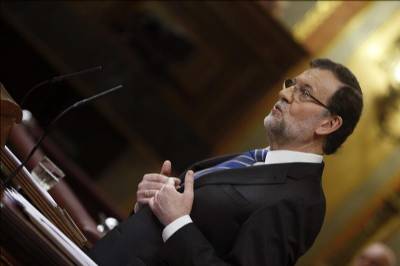
'State of the nation' debate: Rajoy to launch 'social package' to ease pressure on residents
'State of the nation' debate: Rajoy to launch 'social package' to ease pressure on residents
THE last Parliamentary debate on the state of the nation before the next general elections saw president Mariano Rajoy (PP) announcing a 'social package' to 'reward' residents in Spain for their 'sacrifices' in terms of higher taxes and funding cuts.
He intends to encourage companies to take on staff on permanent contracts by making the first €500 of their salary exempt from paying Social Security on the part of the employer.
Social Security, Spain's answer to National Insurance, is payable in part by the employee – a very small percentage of his or her gross salary – but the company has to pay nearly half the staff member's wage again for its own portion, a cost which makes it prohibitive for small businesses in particular to offer jobs.
At the moment, a flat rate of €100 for the first year in Social Security has been established, and the €500 exemption will take effect once this expires.
Reforms in general tax laws mean those with the highest incomes and those who 'deserve criminal reproach' for tax evasion will see their financial details made public, whilst work inspection law changes mean unscrupulous employers have less chance of getting away with paying less than the minimum wage in cash with no contract or Social Security and for longer hours than permitted by the EU, a situation that many non-European immigrants have found themselves stuck in because they need a job.
Benefits will be given for the self-employed when they need to take on another worker to cover for them so they can care for their children aged under seven or dependent family members.
This will cover 100% of the other worker's Social Security contributions for a year, and is aimed at helping the working public balance family and professional life.
Whilst former president José Luis Rodríguez Zapatero's 'baby cheque', or lump sum of €2,500 upon the birth of every child was scrapped years ago, Rajoy wants to introduce a similar concept – although a less generous one.
Families with three or more children under 18, who have direct blood relatives in their care due to illness or disability, and single parents with two or more underage children will get extra benefits of €1,200 a year until all their children are 21 years old, or 25 if they are students.
This will be in addition to the blanket €100 a month given to working mothers with children under three, which has been payable since the year 2002.
Other measures, which have not been made clear yet, will be introduced to support the elderly.
A 'second chance' system will be approved by law allowing individuals and families the opportunity to restructure debts they are struggling with or unable to pay at all, but without having to go to court.
Small businesses will be allowed to negotiate with their creditors before having to call in the receivers, and claims for unpaid debt against companies and individuals will no longer be considered valid after five years, as opposed to 15 years as is currently the case.
Reduced admin and legal costs for individuals and small businesses trying to resolve debt problems – such as commission and penalty charges involved in home repossession – and a greater obligation on the part of lenders to agree to writing off bad debts, delaying payment, providing payment holidays or other ways of reducing the burden will become part of Rajoy's 'second chance' law.
When none of this is possible and an individual person has no other option but to allow his or her property to be repossessed, this shall be considered full payment of the debt in the same way as when a company hands over its assets and declares itself bankrupt.
The Code of Good Banking Practice, which has allowed for over 12,000 mortgage debt restructures and 3,500 people to hand back their house keys in exchange for wiping out the loan – rather than being saddled with it for life in addition to losing the roof over their heads – will be reformed to render so-called 'minimum interest' clauses null and void.
These have led to homeowners paying more than they needed to in mortgage repayments, because in addition to 'ceiling clauses' limiting interest where rates rocket, some loan contracts had clauses stating that repayments may not go below a certain figure, irrespective of whether Euribor interest rates did so.
Such clauses have been deemed 'abusive' and homeowners affected have, in many cases, successfully applied for a refund through the courts.
All physical persons will be exempt from the controversial 'court taxes' brought in two years ago which made almost any kind of legal action too costly for the average pocket, and a maximum period of time for criminal cases to be tried will be set.
A lack of official deadlines has led to situations where reformed drug addicts arrested for minor dealing or possession offences have been sent to prison anything up to 14 years later – by which time, they were completely cured, had jobs, sometimes children and spouses, and in one specific case in Galicia was actually working as a volunteer counsellor to help addicts get off drugs.
It has also meant criminals literally getting away with major offences because the cases took too long to resolve, or seeing their sentences heavily reduced as a result.
Additionally, Rajoy plans to set up 'stolen property offices' so that recovered goods could be returned to their owners more quickly.
As a necessary forward step, Rajoy wants to oblige all town councils to get electronic administration systems in place so that residents can communicate with local authorities and carry out their town hall transactions online rather than having to queue up in person during working hours.
Already, where electronic administration is in place, councils are not allowed to force residents to attend in person or refuse to deal with online enquiries.
Rajoy wants to see this system in place 'not as a philosophy for the future, but as the normal manner of providing public service in the present day'.