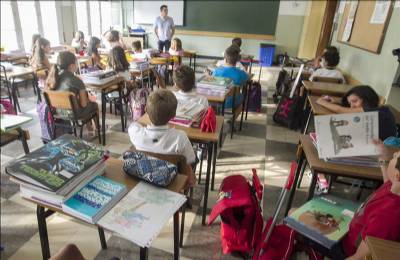
Boys 'perform worse at school because of video games' whilst girls 'read and do their homework', says OECD
Boys 'perform worse at school because of video games' whilst girls 'read and do their homework', says OECD
BOYS are more likely to do worse at school than girls – because of video games, according to a report by the Organisation for Economic Cooperation and Development (OECD).
Although worldwide research over the past few years by the OECD shows a higher level of literacy and numeracy among female pupils, the most recent of these studies says a significant factor is that boys spend more hours a day on video games whilst girls are doing their homework or, when they have finished, are more likely to enjoy reading for pleasure.
The most recent PISA report – a global education survey carried out by the OECD in developed countries – shows that in Spain, of the 15-year-olds who performed the worst in literacy, numeracy and science, 60% were boys.
This report is based on the year 2012, and more up-to-date figures are not yet available.
Girls in Spain were shown to do better in reading and language and boys in maths, and the gender divide grew steadily in the decade preceding the latest PISA report.
The paper said there was nothing 'inherently male or female' about girls performing worse at maths and boys being poorer in literacy, but that girls tend to read more and they also suffer from a greater level of 'anxiety' about number-based subjects.
In countries where girls are generally bolder as a race, their performance at maths was better, in line with their overall self-confidence, compared to in countries where girls are collectively more timid, says the OECD.
The report stresses the urgency of helping girls overcome their number fears and lack of confidence at school, since otherwise, they would grow into women who shied away from two of the careers with the most secure and lucrative prospects, greatest opportunities and the best future – engineering and IT.
In fact, a parallel study by Alicante University shows maths in general 'instils terror' into pupils.
“[Maths] is not a load of formulae invented in some office that have no practical use outside it – maths is the basis of everything and, without it, for example, any modern communication system such as a computer, a sat-nav, a mobile phone or even a Google search engine would be impossible,” says the book Maths in our life by tutors Lorena Segura, Julio Mulero and Juan Matías Sepulcre.
“Leonardo da Vinci, Miguel de Cervantes and Salvador Dalí all used maths. Credit cards and national identity cards, and even the architecture in the Alhambra Palace in Granada use maths – the latter is one of the most explosive uses of maths in art, and the decorative elements of the walls and skirting tiles are based on algebra,” the study reveals.
“We need to show pupils how maths is a practical subject, and eradicate the widespread fear and lack of interest in it which pervades most classrooms.”
As for reading ability being better in girls versus boys, the PISA report found that in all OECD countries including Spain, 74% of boys say they are great fans of video, internet and PlayStation games, whilst 56% of girls say they never played them at all.
And 20% of boys spend at least an hour every day on virtual games, compared to 2% of girls.
By contrast, when girls were at home and not with their friends, they were more likely to get their homework done and, in their down time, read books rather than play computer games.
Girls spend several hours a day more on reading than boys – and on better-quality literary material, says the OECD.
Whilst boys' reading time is mostly spent on comics, girls tended to read fiction novels and magazines, which are more text-heavy than comics.
“Reading ability is the basis of learning – if a person does not understand what he or she reads, this has a negative effect on all other subjects,” said OECD boss Stefan Kapferer at the ABC Gender Equality in Education conference broadcast this week simultaneously in Berlin, Tokyo, Washington, London, Paris and Madrid.
“Every hour not spent on reading or studying translates to a fall in academic performance of 4%,” Kapferer concluded.