Teen killer, who 'drew Nazi symbols on his desk', cannot face criminal charges because of his age
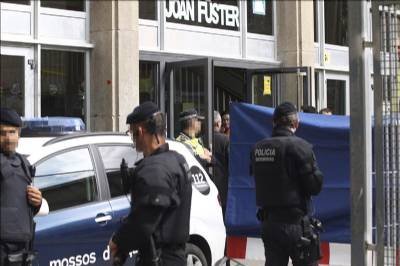
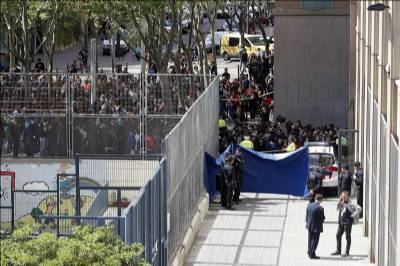
THE 13-year-old who murdered a supply teacher with a crossbow and injured two others had drawn Swastikas on his desk, according to sources from the Joan Fuster high school in Barcelona.
At least one of the unnamed pupil's classmates says he had compiled a blacklist of teachers and other students whom he 'did not like', and that although he talked of killing those on the list before committing suicide, they did not take him seriously.
He had made the murder weapon, a crossbow, himself out of wood and pens, having 'easily' found instructions for doing so on the internet.
The child also brought a machete and a home-made Molotov cocktail with him, which teachers just managed to stop him from blowing up in time.
Despite the murder having been planned, the teenager cannot be held criminally responsible – or even liable under civil law – because he is too young.
Spain's Minors' Law, which dates back to the year 2000, says under-18s cannot be found guilty of a criminal offence, although they are considered liable for their actions, and under-14s may not be held responsible at all.
This means the pupil cannot be held in custody, or even in a youth detention centre – unless he is found to be suffering from a certifiable psychiatric disorder that requires a hospital stay as an inpatient, he will remain free.
'Rehabilitation therapy' and 'a normal life'
The Child and Teenager Attention Unit, DGAIA, will handle his case and he will undergo a full examination by a child psychiatrist.
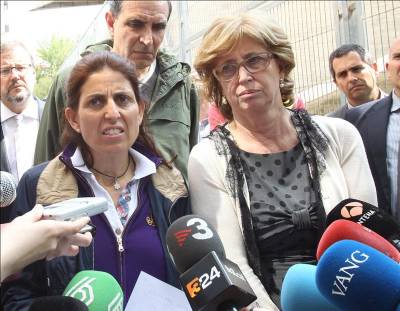
Regional education minister for Catalunya, Irene Rigau (second photo, on the right, with headmistress Dolors Perramón on the left), says initial reports show the child killer may have had a psychotic outburst, which would tie in with reports from teachers and classmates that he had 'heard voices' telling him to kill tutors and pupils at the school – voices which became 'more and more powerful' over the weekend.
Any rehabilitation will centre on re-educating the teenager via psychologists and specialists in child schooling and behavioural therapy.
The aim will be to make sure he 'does not do it again', either at 14 years old when he would be able to be held responsible at law – although not be treated as a criminal – or later in life.
If his parents are found to be 'fit' and he is not living in a dysfunctional environment, the re-education will centre on the child himself rather than on his family unit.
He could have 'anything from three to 10 sessions' with the rehabilitation team, but will otherwise 'lead a normal life', according to the director-general for child services in Catalunya, Mercè Santmartí.
She says children are sent to the DGAIA for rehabilitation for any anti-social offences – starting with 'setting fire to a waste-paper bin'.
Spain's government says it 'has no plans' to change the law to make younger children criminally responsible, but will merely 'investigate the violent surroundings' of the child population.
“Something is going wrong in society: young people are exposed to more and more violence, in TV serials, in films, in social networks, in video games,” says secretary of State for social services and equality Susana Camarero.
“This is a situation we need to work on and where we need to think seriously about what is happening.”
She adds that the current generation of children and teenagers are 'digital natives' but 'do not appreciate problems and new types of violence' which are 'manifested on the internet'.
Sra Camarero adds that 'as a mother', she thinks the solution lies in parents 'spending more time with their children'.
“Monitoring, accompanying, educating on correct behaviour, and upbringing in general are tasks that should be carried out in the family,” she concludes.
Criminal liability in the western world: From age seven in North Carolina to 18 in Greece
European Union countries, especially in southern Europe, are the most lenient in terms of minimum criminal age – in Spain and Italy, under-18s are considered 'minors', or effectively 'children' in every sense, whilst under-14s are considered 'small children', and although those aged 14 or over are considered legally responsible for their behaviour, they cannot face criminal charges.
France considers children aged 13 or over can be criminally responsible, and from 10 and over, can face 'sanctions and behavioural education measures', but never in a criminal sense.
The Netherlands and Belgium hold children aged 12 and over criminally liable, whilst in Greece, those aged 10 to 13 inclusive can only be given 'treatment and rehabilitation' and nobody is considered a criminal until he or she is aged at least 18.
England and Wales – the UK excluding Scotland and Northern Ireland - reduced the minimum age of criminal liability to 10 years after the horrific murder and torture by two boys of this age against two-year-old Jamie Bulger.
In the USA, however, 33 out of the 51 States do not have a minimum age, meaning a child can, in theory, face criminal charges at any age.
Among those which do stipulate a minimum, the highest of these is in Wisconsin where a child can be charged with a criminal offence from age 10, and the lowest is in North Carolina, where anyone aged seven and over can be considered a criminal.