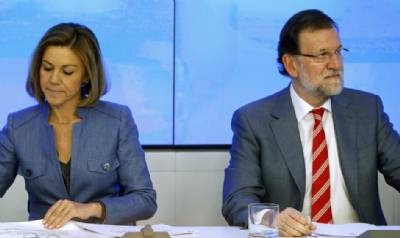
Rajoy reveals 'disappointment' at election results, but insists PP 'has won'
Rajoy reveals 'disappointment' at election results, but insists PP 'has won'
SPAIN'S president Mariano Rajoy has spoken to his cabinet after the regional and local elections in a much-anticipated meeting after the PP lost 2.5 million votes and saw its outright majority in the country's 17 federal communities disappear overnight.
Rajoy said unnecessarily that the results were 'not what he had hoped for', although thanked the six million voters who had 'shown their confidence' in the party.
But the fact the PP still earned the highest number of votes 'proves it is still the favourite' for 'the Spanish', said Rajoy.
"The PP's victory is unquestionable, but we have not attained the majorities that the people of Spain gave us four years ago, so we are not satisfied - denying this is as absurd as denying we've won the elections," the president commented.
"I'm not going to shield myself from the disappointment by reminding myself we're the most-voted-for party, because we want more. The PP will continue to work either as government or as opposition for Spain's recovery - our aim is for people's quality of life to improve."
Rajoy continued to stress the importance of 'stability' in government because 'economic recovery is easier this way' and that consistency in ruling is 'valuable'.
"When it comes to negotiating pacts or coalitions, our philosophy is the creation of transparent and stable alliances, but always respecting the most-voted candidate lists," Rajoy continued.
Echoing the words of the winning candidate for Madrid's regional presidency, Cristina Cifuentes, Rajoy admitted the PP needed to be 'closer to the people' and that it suffered from 'communication problems', but said the poor results would not have any negative consequences for the government itself or the PP.
"I've been with this party for many years and I'm very comfortable and content here. I have no plans to make changes - I don't believe the problems come from changing or not changing, and I intend to run for presidency again at the general elections."
He has finally admitted that the corruption cases blighting members of the PP had indeed affected the results of the local and regional elections, but insisted that those which had come to light in the months leading up to the elections dated back from 'a very long time ago'.
"I'm absolutely convinced that the Spanish people will recognise, in the forthcoming general elections, the efforts we have made in helping Spain recover - I agree we have made mistakes, but we have worked hard both at central and regional government level and in local councils to end the financial crisis - efforts which I believe will be recognised by voters who they go to the polls at the end of the year."
Overall, the PP's loss has not been a complete disaster for the party, with nine out of the 13 regions which voted in new governments on Sunday casting their ballots in favour of the far-right party, as was the case in 40 provincial capitals and in town councils in 27 provinces.
Four regions did not vote in governments on Sunday, only town councils - Andalucía, which held its elections in April; Catalunya, whose regional elections are due on September 27; the Basque Country, and Galicia in the far north-west.
But as Rajoy points out, local council election results do not necessarily reflect those of the general elections.
Political ideology at local level is far less pronounced, with many die-hard PSOE voters ousting their local socialist governments for the same reasons they would not vote for the PP in the general elections, and vice versa with lifelong PP voters.
Local election voters tend to cast their ballot in favour of the party whose manifesto they believe will make the biggest positive difference to their lives, or tactically against those whose mandate they believe would worsen their quality of life.
In smaller towns and villages, local council voting can become a popularity contest, since candidates on the party lists, and their leaders, are usually very well-known to members of the community.
Nationalist parties such as BLOC-Compromís in the Comunidad Valenciana, which is in favour of the Valencian language becoming the lingua franca and the region being independent, would not normally allow non-Valencian candidates at regional level on their lists, let alone foreigners, but in local councils in the region, many branches of BLOC-Compromís have more than one expatriate, European or non-EU, in prominent places in their line-up.
Regional election results are a far greater reflection of what may happen in national elections, due to the greater proximity between branches of the different parties - the ties that bind Rajoy's cabinet to regional PP parties are much more close-knit than those between a PP party in a local council and the presidential office in Madrid.