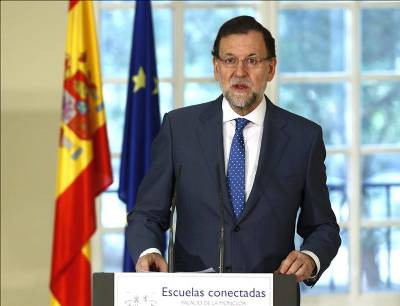
Rajoy denies general elections will be in September or December, but is 'not sure' if they will be in November
Rajoy denies general elections will be in September or December, but is 'not sure' if they will be in November
SPANISH president Mariano Rajoy has denied rumours that the general elections may be put back to December this year, although he has previously countered claims he was thinking of bringing them forward to September.
When asked about when Spaniards may be going to the polls, the PP leader replied that 'to be absolutely frank' he did not yet know what the date would be.
Rajoy merely confirmed the elections would be 'at the end of the year'.
At first he said he 'could not be sure' that the nation would be casting its ballots in December, but in a subsequent interview on Spain's Channel 5, TeleCinco, the president gave a firm 'no' when asked if election day would be a date on the Advent calendar.
This said, when the TV reporter asked if the elections would be in November, Rajoy replied that he 'could not say'.
As a result, nobody is really sure when they will be voting in their national government for the next four years.
Former Madrid regional president and unsuccessful mayoral candidate for the city, Esperanza Aguirre, who is also on the PP has told Rajoy he should hold elections in September to coincide with the regional polls in Catalunya.
And rumours began that the elections would indeed be brought forward, but Rajoy denied those.
His immediate rival, PSOE leader Pedro Sánchez, has publicly called for the president to convene the general elections 'now'.
But Rajoy says before he dissolves Parliament, he wants to get next year's budget agreed and rubber-stamped in order to provide 'certainty and security'.
"I'm going to work with diligence, reason, arguments, and by speaking to as many of the Spanish public as I can," Rajoy announced.
And his in-tray is full to bursting, with 46 pending new laws he wants to get signed off before the elections.
They include a controversial reform to the abortion law, which forces women aged 16 or over but under 18 to obtain their parents' written permission before terminating a pregnancy - a requirement which could put many young adults in danger especially where they are from cultural backgrounds that could mean they are forced to marry a rapist or suffer violence or destitution by their families, or in the case of women who know they face serious reprisals if their parents found out - as well as those of staunchly-traditional Catholic faith where their parents may withhold permission and force their daughter to have the child..
Many of the new laws - as well as existing ones brought into effect since Rajoy came into power in November 2011 - are likely to be abolished if a new government takes over.
General elections in Spain always used to be held in May every four years, the year after the local and regional elections, meaning the last generals should have been held in May 2012 and the next ones would be due to take place in May 2016.
But former president, socialist leader José Luis Rodríguez Zapatero, disillusioned and ready to throw in the towel, called elections six months early in November 2011 which would mean the four-year term of office is over in November this year.
Rajoy says he feels comfortable leading his party and plans to stand again for elections, meaning any murmurings of a possible early date for going to the polls appear unlikely to be founded.