Free tapas with a beer or wine still offered in 10 towns and cities in Spain
Free tapas with a beer or wine still offered in 10 towns and cities in Spain
BAR customers get free tapas in at least 10 Spanish cities, according to recent travel research – and, contrary to popular belief, not all of them are in the southern region of Andalucía, said to be the home of this highly-traditional form of dining in Spain.
Tapas, generally 'nibbles' to fill a gap between meals, were traditionally eaten by land workers on breaks and the name came from the lids, or covers they put over their wine or water jugs to keep flies and dust out of them and which doubled up as food plates – tapar is the Spanish verb for 'to cover'.
Nowadays, although they are eaten throughout the country, the tradition is not as great in many regions as in Andalucía and, many decades ago, tapas would be handed out one at a time free of charge with every drink ordered, rather like a dish of peanuts, crisps or olives sometimes are nowadays.
But they have also become a restaurant staple in Spain and abroad, either as a small starter, or several ordered and delivered in a constant stream – usually for sharing – as a starter and main course combined.
This said, even a plate of crisps counts as a tapa, but the price tends to be higher than a packet ordered over the bar in a locale that serves drinks only.
Tapas has become as synonymous with 'typically-Spanish food' as paella, which in practice originates from the Valencia region and is much less prolific inland or in the north.
The 'free tapa with every drink' tradition died out long ago as bars sought to maximise profits, although in Andalucía, it took longer to peter out.
Yet some entire cities in Spain continue to do so in practically every bar.
It may come as a surprise that many of these are in the Basque Country, but this far northern coastal region has always, in fact, had a strong tapas tradition – although in a different format from the rest of Spain.
Here, tapas are skewered onto cocktail sticks of different shapes and sizes according to price and are known as pintxos (second picture), and after diners have had their fill, the sticks are counted up to calculate the bill.
A recent study by food and travel writers in a national Spanish daily newspaper showcased 10 towns and cities across the country, often in areas not considered a typical tapas haunt, where freebies still come with drinks.
Alcalá de Henares, in the Greater Madrid region, is the epitome of 'classical Spain' and its most popular attractions include the Plaza de Cervantes, the cathedral and its narrow side-streets, the pillars on the C/ Mayor and the university, and in many of the bars a tapa is thrown in with every drink.
With over 30 to choose from in most, they include 'international' snacks such as mini-hamburgers and mini-sandwiches, crisps and scrambled eggs – although admittedly, the average price of a half-pint of beer, or caña, at €2.80, goes some way towards covering the cost of the tapa for the bar owners.
Locales recommended by the writers are Índalo, El Tapón and Maimónides.
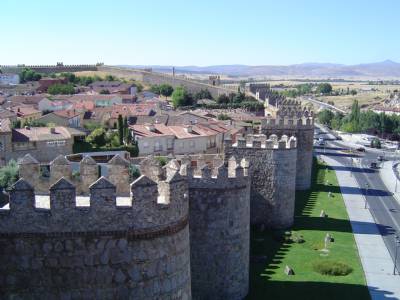
Ávila (third picture), in the centre-northern region of Castilla y León, a beautiful and ancient walled city just a short train ride from Madrid and very much worth the detour, is ideal for meat-eaters since its bars feature very inland-Spain cuisine in the free tapas served with drinks.
Bars recommended include the Barbacana, El Rincón, Gredos, Don Camilo, Las Cancelas, and El Rincón de Jabugo, and a half-pint of beer typically costs between €1.20 and €1.90.
Also in Castilla y León, practically every bar in the city of Segovia offers a choice of tapas free with a drink, especially those in the centre such as San Miguel, Los Tarines and Restaurante Duque, and a caña normally costs around €1.20.
Castilla y León includes four of the 10 towns and cities featured where tapas <>