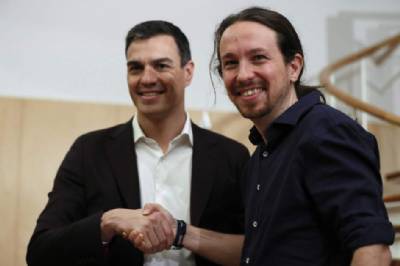
Spain could have a government very soon: Podemos and Ciudadanos show more flexibility
Spain could have a government very soon: Podemos and Ciudadanos show more flexibility
SPAIN is 'much closer' to forming a government at last following meetings between the PSOE and left-wing independents Podemos.
The latter's leader, Pablo Iglesias, has even said he would be prepared to not form part of the cabinet if it is he himself who is standing in the way.
Iglesias said he would be 'willing to give way' over some of his key proposals, including the fiscal reform, increase in public spending and relaxing the rules over the State deficit.
“We're prepared to talk about things and even accept proposals that we're not particularly enthusiastic about,” Podemos' leader reveals.
“When you negotiate in politics, you have to be prepared to give in a little. Our programme is a good starting point, in our view, but we're willing to make concessions – although it can't just be one party to the deal who does so; everyone has to.”
He presented PSOE leader Pedro Sánchez Castejón with a list of these concessions.
They include 'reducing the State debt at a greater pace' than Iglesias initially wanted; 'accepting a tax reform which is less distribution-based'; 'increase public spending by €60 billion rather than €90bn', and to scrap the 'most recent' labour reform – the one brought in by PP leader Mariano Rajoy's government, but not the previous one applied by the socialists when they were led by ex-president José Luis Rodríguez Zapatero.
“I would agree not to be a member of the future cabinet if this would help create a 'Valencian-style' coalition,” Iglesias said, referring to the regional government in the eastern provinces which is made up of the PSOE, Podemos and the left-wing party Compromís.
But Iglesias does not envisage Podemos being part of a government which includes Ciudadanos – and Ciudadanos has already said it will not work with Podemos.
Podemos, however, is now ready to agree to three-way talks with Ciudadanos and the socialists.
Iglesias said his desire to allow a referendum on independence in Catalunya was 'no longer a red line', but that instead the best way forward would be to start talks between the regional socialist party and Podemos' Catalunya faction, En Comú Podem, to seek a solution to the 'territorial crisis' in the region.
Concerning Podemos' alleged 'in-house crisis', which involved party secretary Sergio Pascual being removed from his post – upsetting Podemos' second candidate on the list, Íñigo Errejón – Iglesias stressed Errejón had 'one of the best brains in Spanish politics' and he was very happy for him to carry on working at the sharp end of the party's affairs.
“I was obliged to adopt essential improvements in the organisation, and we're all very enthusiastic about Pablo Echenique becoming our new secretary,” Iglesias insisted.
He pointed out that it was 'about time' political leaders 'started to roll their sleeves up' and 'not be afraid to get their hands dirty.
Ciudadanos admits its PSOE deal 'could be better'
Another meeting with centre-right, or liberals, Ciudadanos has led to the party conceding that its controversial deal with the PSOE 'has room for improvement' and should be amended if need to to break Spain's political impasse.
PSOE (socialist) Congress spokesman Antonio Hernando admitted that to repeat the general elections – unprecedented in Spain's democratic history – would be 'a disaster' and a 'failure'.
“And the worst that could happen as a result would be for Sr Rajoy [PP leader and caretaker president] to continue governing,” Hernando stressed.
Although the PSOE-Ciudadanos deal is 'valid' and would be applied if the parties formed a government, said Hernando, the two political outfits 'could do better'.
And PSOE leader Pedro Sánchez Castejón, who was formally invited by King Felipe VI to form a government of which he would be president, will 'continue to offer the opportunity for dialogue'.
The stumbling block, however, remains the refusal by both Podemos and Ciudadanos to work together.