Live liver donation from adult to baby via laparoscopy is a first for Spain
Live liver donation from adult to baby via laparoscopy is a first for Spain
THE FIRST-EVER live-donor liver transplant via laparoscopy from an adult to a baby has been carried out in Córdoba's Reina Sofía University Hospital between a nine-month-old girl and her aunt.
Ana Rodríguez, 35, underwent a 'minimally-invasive' procedure to extract a small portion of her liver – one of the only organs, along with a kidney, which can be donated from a living person, given that the liver regrows inside the recipient and a person only needs 10% of the organ to be able to survive.
The donated organ part was immediately transferred to Emma, who is now 11 months old but who, at the time, was suffering from a rare congenital condition which shuts down her bile ducts.
She had undergone an operation to open them up as a temporary measure to keep her stable until the transplant could be performed.
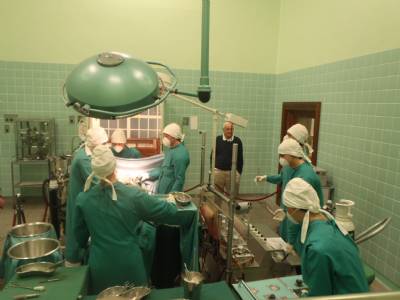
For the two operations to be carried out, 25 professionals in two operating theatres spent 11 hours on the donor and recipient.
Baby Emma only had to spend three weeks in hospital, whilst her auntie Ana was discharged within four days.
Surgeon Dr Javier Briceño says the laparoscopy technique, whilst 'highly complex' and requiring 'great precision', brings considerable advantages to both patients – it is far less aggressive than conventional surgery, the post-operative recovery stage is reduced and the donor can get back to her usual routine and work very quickly.
The surgeon's own vision improves with the laparoscopy technique because everything appears much bigger on the screen, and allows for much more accurate blood-flow monitoring, Dr Briceño says.
Although previous cases involving live liver donation via laparoscopy have been successful in Spain, this is the first time in which the donor has been a baby rather than an adult.
The techniques employed are vastly different, since the blood vessels have to be adapted to the size of a much smaller patient and the dissection of the organ has to be far more accurate.
Very few hospitals use the laparoscopy method at present, and the Reina Sofía in Córdoba is one of just a handful which does, employing the technique in 30% of conventional liver transplants – in 2015, a total of 40 out of 130 operations, just two years after it began to use this less-invasive model.
Two months on from her operation, baby Emma has made a full recovery, and her aunt was back at work within less than a week.