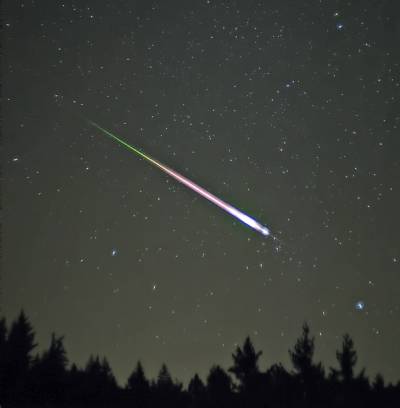
Fireball seen in skies above Murcia, Andalucía and central Spain
Fireball seen in skies above Murcia, Andalucía and central Spain
A FIREBALL brighter than a full moon was seen crossing Spain in the early hours of yesterday (Saturday) morning, caused by a meteoric rock hitting the Earth's atmosphere at 95,000 kilometres per hour (nearly 60,000mph).
It was caught on telescope at the La Hita observatory in Toledo at 23.06hrs exactly, and was seen from the ground by the naked eye from Murcia, Andalucía, Castilla-La Mancha and Madrid.
Meteor detectors set up by the University of Huelva, on Spain's far south-west coast, based in Sevilla, the Sierra Nevada, Calar Alto (Almería province) and Huelva city itself were designed to monitor the skies continuously to enable astrophysicists to analyse the impact of burning space rocks coming from the Solar System and colliding against the Earth's atmosphere.
These studies, part of the so-called SMART project, found that the fireball soared directly over northern Africa, which is why it was bright enough to be seen from southern and central Spain.
The brusque collision with the atmosphere forced the temperature of the meteoric rock to shoot up very suddenly, creating a fireball at an altitude of 107 kilometres above Morocco.
It then headed north-west, disintegrating and fizzling out at 74 kilometres above the earth.
Fragments coming away from the comet 169P/NEAT cause a glittery firework display of stars known as the Alpha Capricorn Shower, and which can be actively seen from the beginning of July to mid-August in the northern hemisphere.
The star-shower usually creates extremely bright fireballs which are seen from parts of earth, as was the case with the one spotted in the early hours of Saturday morning.
Studying fireballs enable astronomers to determine the physical and chemical properties of comets.