Typical DAESH member in Spain 'clueless about Islam', research finds
Typical DAESH member in Spain 'clueless about Islam', research finds
NINE in 10 of the Jihad terrorists arrested in Spain in the last three years have 'no relevant knowledge of Islam', according to investigators and researchers specialising in DAESH, or the so-called Islamic State.
A typical Jihad fighter in Spain is aged around 30, married, and either Moroccan or a Spanish national of Moroccan origin, with only 6% being pure-bred Spaniards with no foreign roots in the previous four generations.
Marginally fewer Jihad terrorists in Spain are second-generation migrants – 42.2%, compared with 51.7% who are first-generation immigrants.
They generally have a low level of education, with no qualifications beyond compulsory schooling to age 16, and it is very rare to find any who have been to university, according to the Royal Elcano Institute (RIEC)'s Global Terrorism unit and expert researcher in the field, Carola García-Calvo.
Generally, they were unemployed, but the researchers said this is not an reliable indicator given the high level of joblessness in Spain as a whole among the rest of the population – 21% in total, and nearly 50% among the under-30s.
The study covers details of all 124 DAESH recruits who have been arrested on Spanish soil, or Spanish residents caught elsewhere in the world, since June 2013.
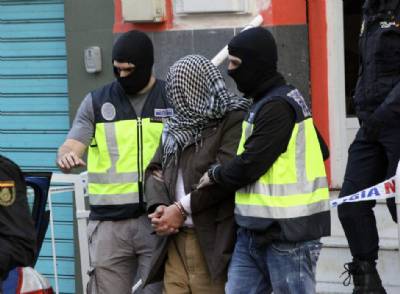
In the majority of cases, Jihad arrests by Spanish authorities were for suspects involved in online recruiting and indoctrinating rather than actual front-line fighting or terrorist attacks, although a worrying 35% of them had the clear intention of staging a massacre in Spain and the resources and ability to do so.
Crucially, though, although 62.8% became radicalised for 'ideological reasons' rather than emotional, personal or political motives, the overwhelming majority have extremely limited knowledge of the Islamic faith and are largely unfamiliar with the teachings of the Q'ran.
In terms of location, and although DAESh recruits have been caught in many parts of Spain – even unlikely areas such as Gandia and Xeraco in the south of the Valencia province – the main breeding ground for radicalisation is the Spanish-owned city-province of Ceuta on the northern Moroccan coast, where 60% of those arrested had been born, almost exclusively to Moroccan parents due to the geographical location of the enclave.
Barcelona is the main centre for Jihad plotting, with 27% of arrests having been made in the city itself or the wider province.
The report by the RIEC dispels the myth of so-called 'lone wolves' being the most prolific DAESH followers – only 5.6% were described as such, with the remaining 94.4% acting in groups, and the sole operators were mainly involved in propaganda.
Eight in 10 suspects had grown up in a Muslim family,with 27.7% having been radicalised by their own relatives – in fact, two-thirds were related in some way to at least one other suspect, or were friends or neighbours.
Whilst elsewhere in the world, online recruiting is thought to be the key strategy, in Spain a significant minority – 29% - had been indoctrinated in person, and 52.7% by a combination of both.
A total of 23.5% of those arrested had joined DAESH due to an 'existential crisis'.
The report refers to one suspect in question, a Moroccan man, whose telephone conversation with a friend was recorded.
He said: “I reached a point, my friend, where the world meant nothing to me, I swear to you. I had a moment where...I hated life and wished I was dead.”
Another 13.7% became 'radicals' for emotional reasons, mainly hatred against the west, with one terror suspect having written on social networks the day after the Paris massacre: “Friday was one of the happiest days of my life, seeing the terror on their faces was priceless.”
Between November 2013 and April this year, a total of 160 Jihad terrorists managed to get out of Spain and enter Syria and Iraq.
Of these, 29 have been killed in combat and another 20 have made it back to Spain.
Another recent report by prominent US Intelligence member Michael Flynn revealed that the majority of DAESH members 'watch a lot of porn'.
He found a disproportionately high exposure to pornographic film footage, some of it involving snuff movies and children, with a lot of it being especially violent.
Eight in 10 computers seized from Jihad suspects contained more graphic pornography than any other data when analysed, Flynn revealed.