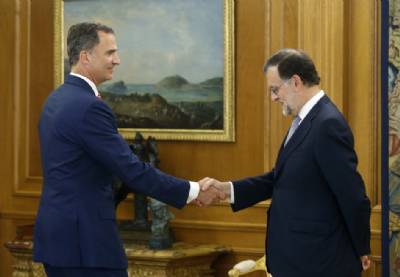
King meets party leaders: Rajoy accepts nomination, but ‘may not turn up’ for in-house election
King meets party leaders: Rajoy accepts nomination, but ‘may not turn up’ for in-house election
SPAIN’S prospects of avoiding a third general election appear slimmer than ever after King Felipe finished his round of consultations this week with party leaders.
Acting president Mariano Rajoy has warned the monarch he may not turn up to the in-house voting if he does not gain enough support from the other parties, mirroring the aftermath of December’s failed general election.
But he has accepted the King’s nomination for him to form a government, which he rejected last time around based upon his lack of support.
PSOE leader Pedro Sánchez has reiterated he will vote ‘no’ to Rajoy, whilst centre-right Ciudadanos’ leader Albert Rivera – whose party is the only one Rajoy may be able to count on for back-up – says it wants ‘either a united government with a clean record’ or one of the PP, Rajoy’s group, in minority.
And left-wing independents Podemos, led by Pablo Iglesias, says this time around the possibility of a left-wing coalition government appears ‘more difficult’ and ‘farther away’, especially as his failure to reach an agreement with Sánchez – even voting against him in the presidential in-house election – means the PSOE has not made any attempt to strike a deal with them.
The PNV, or Basque Nationalist Party, and Catalunya Convergence and Democracy (CDC) were rumoured to be planning to support PP leader Mariano Rajoy in the in-house presidential elections - originally due for next week, but now delayed further - to ensure the right-wing party would get back into the hotseat despite only holding 134 seats out of a required majority of 176.
But both made it clear to Felipe VI they would vote ‘no’ to Rajoy as president.
Spokesman for the Catalunya version of left-wing Podemos – known as En Comú Podem –Xavier Domènech commented on the monarch’s ‘serious concerns’ about the political impasse, whilst Alexandra Fernández of the Galicia branch of Podemos, En Marea, said Felipe VI had stressed to her during their meeting that it was ‘absolutely vital’ to ‘avoid a third election no matter what’.
Domènech proposed to the King that if Rajoy did get into power, the rest of the parties – Podemos, the socialists or PSOE, Basque separatists EH-Bildu and the pro-independence Catalunya groups – should band together to form a ‘useful opposition’ enabling them to propose legislation initiatives they built up together in the knowledge that there were enough of them to push them through because of Rajoy’s governing in a minority.
Rajoy has asked Felipe VI for more time to drum up support, and his former public works minister Ana Pastor – now head of Parliament – says the date for the in-house presidential election ‘has not been decided’.
This leaves Spain in limbo yet again and unable to address serious issues such as cohesion in Europe in the face of the Brexit vote, refugee crisis and terrorism threat, the approval of the 2017 State budget, measures for mopping up the ongoing national debt, and for approaching the excessive level of unemployment.
Sánchez, however, says it is up to Rajoy to proactively negotiate, and has criticised him for ‘letting all the other parties do his work for him’.
All leaders stressed there would not be a third election, but the Spanish public is sceptical of this pledge.
The parties have until October 15 to reach an agreement.
In the meantime, the King will launch a second round of consultations with party leaders from today (Friday) over the next week.