Rajoy to meet with PSOE and Ciudadanos leaders to discuss programme points in common
Rajoy to meet with PSOE and Ciudadanos leaders to discuss programme points in common
A KEY week for Spanish politics kicks off today (Tuesday) with meetings between acting president Mariano Rajoy (PP) and leaders of the PSOE, or socialists, Pedro Sánchez and centre-right Ciudadanos, Albert Rivera.
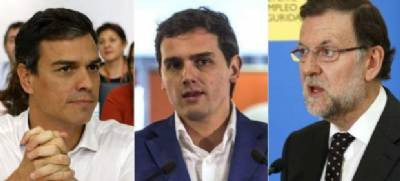
Having said he is not sure whether he will even turn up to the in-house presidential elections as he does not believe he has sufficient support, Rajoy (pictured right) postponed the investiture session sine die after being nominated to form a government by King Felipe VI.
But the session is expected to take place by August 26 at the latest, since Spain needs to send its debt forecast for the forthcoming year to the European Commission and approve the 2017 State budget.
Ciudadanos has agreed to abstain in the in-house round, but it appears its leader, Rivera (pictured centre) may decide to vote in favour of Rajoy’s taking over as president again if the vote goes into a second session.
He reportedly asked the King to ‘try to persuade’ the PSOE to at least abstain, if not vote in favour to let Rajoy through – but the Monarch’s role in elections is merely as a go-between, and he is not allowed to influence parties either way.
The PSOE’s leader Pedro Sánchez (pictured left) remains firm with his refusal, but unlike after the December elections, has not made any steps to form an alternative government after relations with left-wing Podemos’ leader Pablo Iglesias broke down – and the PSOE back-benchers are divided over whether or not the party should team up with Podemos.
Some have vetoed the idea altogether.
Pointedly, and despite Podemos being the party with the third-highest number of MPs, Rajoy has not arranged to meet with Iglesias.
If Rajoy manages to get back into power, it will be through the main parties abstaining in the voting round, rather than through votes in his favour.
Neither Sánchez nor Rivera were impressed with Rajoy’s 55-page programme for governing, calling it ‘unambitious’, ‘more of the same’, and lacking in methodology.
Rajoy has since compared his own plan with the joint agreement Sánchez and Rivera drafted after the December elections – an agreement which led to Podemos voting against Sánchez – and says he has found 125 points which match his own, and which he wishes to build on.
Those he has not listed for discussion include scrapping provincial councils, or Diputaciones, whose main role is allocating funds to towns and villages which come from the central government, which they act as an outpost for and are not directly elected.
Spain has long been considered to have ‘too many cooks’ – a disproportionately high number of politicians and layers of government – and many economic and political experts say the country simply cannot afford to keep them all.
Except for a few local council leaders, none has volunteered to cut their own expenses or wages, which are taxpayer-funded – and with unemployment still at around 20%, despite a temporary drop for the summer tourism season, taxpayers are fewer in number and contributing less.
According to a Metroscopia survey, nearly two-thirds of PSOE voters would support the party abstaining to get Rajoy into office ‘by omission’, provided the PP made certain concessions, mainly on the social welfare front.
Sánchez said it would go against his voters and his own party if he did anything to facilitate the return to office of a party and president the PSOE has worked to keep out of the hotseat.
Meetings will be held at 09.30hrs today (Tuesday) and 11.30hrs tomorrow (Wednesday).