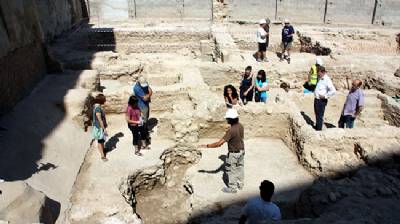
EXCAVATIONS in the popular expat town of Tortosa (Tarragona province) have uncovered a chunk of a fifth-century Roman city wall – the oldest archaeological finding to date in the area.
At 40 metres (130 feet) long and three metres (9'9”) high, the boundary wall found in the plot opposite Tortosa cathedral acted as a fortress for what was known in the late Roman era as the city of Dertosa.
Other than remains of walls belonging to residential homes, or human remains, pottery and similar artefacts, nothing of such outstanding historical value dating back to this era has ever been found on the Costa Daurada, archaeologists say.
Mediaeval home foundations, dating back to the Arab or Andalusí era, have been found on the site already, but these are far more common along Spain's eastern and southern coasts, and even the public square built in the first or second centuries, in the Roman times, are more run-of-the-mill than the recent discovery of the city wall.
Tortosa town hall is working on ways of preparing the dig to allow visitors to wander round and find out for themselves what the municipality was like during the Roman Empire, once it has been able to invest more money and time in building the new Plaza which will open out the cathedral complex to the banks of the river Ebro.
The Roman square and boundary wall is made from what was known as opus caementicium – literally, 'cement works', or a mix of mortar and stone, historians reveal.
It is possible that the wall acted as a flood barrier, although archaeologists believe the Roman houses and public buildings in the area may have been constructed partly to serve the same purpose.
The city wall was re-used during the Islamic era, when the town was known as Turtusa, in the ninth and 10th centuries, and another layer built on top to make it higher.
According to the excavation team, the city wall is in excellent condition for its age.