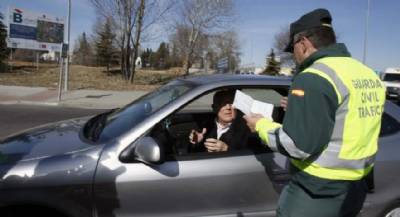
A 56-YEAR-OLD man from the Basque Country has broken the world record for drink-driving after he was found to have travelled 240 kilometres (150 miles) at nearly 10 times the legal limit.
He was breathalysed by the Gendarmerie on the A-89 motorway linking Bourgogne and Perigueux, when they saw him parked on the hard shoulder in the town of Saint-Seurin-sur-l'Isle.
Officers said he stank of alcohol and was too drunk even to complete the breathalyser test, so they took him to the nearest hospital.
A blood test was carried out, and the reading showed 4.75 grams of alcohol per litre of blood, or 475 milligrams per 100 millilitres – nine-and-a-half times the legal limit for France or Spain.
The driver admitted later that he had had no idea where he was driving to, nor how much alcohol he had drunk beforehand.
He has provisionally been banned from driving for six months, but will appear in court in Libourne in southern France in October.
Spain's alcohol limits are 0.05% – 50 milligrams per 100 millilitres of blood or 0.25 milligrams per litre exhaled in a breathalyser test – dropping to 0.03%, or 50 milligrams per 100 millilitres of blood and 0.15 milligrams per litre exhaled, for drivers of HGVs of 3.5 tonnes or more, of passenger vehicles with more than nine seats, or with less than two years' driving experience, and attracts a fine of between €500 and €1,000.
More than double the limit means a six-month jail term, which is suspended if it is a first criminal offence, and a four-year ban.
This is much lower than in the UK, where the breathalyser reading maximum is 0.35 milligrams per litre or 80 milligrams per 100 millilitres of blood.
France's limits are the same as Spain's, but a reading of 0.08% or over is a criminal offence rather than, as in Spain, 0.12%.
Anything over a standard glass of wine – 175ml – or a pint of beer, being two bottles (tercios) or glasses (cañas) is enough to put an average-sized male or female over the limit in Spain, and can take up to four hours after finishing to fully metabolise enough for the drinker to possibly be safe to drive.
This means the offender is likely to have drunk the equivalent of 10 glasses or nearly two litres of wine, 10 pints of beer, or nearly half a litre of spirits.