Valencia secondary school refuses entry to pupil in hiyab, or headscarf
Valencia secondary school refuses entry to pupil in hiyab, or headscarf
A HIGH school in Valencia has sent a pupil home and refused to let her back into class unless she takes off her hiyab, or headscarf, reports SOS Racism.
The teenager is Muslim and of Moroccan descent, but was born in Spain and has Spanish nationality, and wears the hiyab out of choice, and when she was ordered on the first day back at school after the summer break to take her scarf off, she reported the incident to the Valencia-based branch of the anti-xenophobia charity.
Other organisations the complaint has been shared with include Movement Against Intolerance, the Civic Platform Against Islamophobia, and Valencia's Islamic Cultural Centre, and it has been referred to the regional and national ombudsman.
According to the pupil, she was called into the headmaster's office on the first day of term and told 'in no uncertain terms' to remove her hiyab and that she would not be allowed back in school the next day if she was still wearing it.
She has now missed over a week of school as a result.
The various organisations have been in contact with the regional education minister, who sent out the schools inspector to investigate.
Once the inspector was confident the pupil's version was completely accurate, he called the headmaster to his office for a meeting to 'request he change his attitude'.
The inspector said the headmaster had made a 'closed and literal interpretation' of a school dress code article which forbids students from wearing headgear in class, but which was drawn up with the aim of preventing them wearing balaclavas, baseball hats or woolly hats pulled down to cover their faces.
SOS Racism points out that the hiyab does not cover any part of the face, only the hair and neck, and criticises the fact that it 'has had no effect whatsoever' explaining to the headmaster that the rule 'must be interpreted appropriately' and 'in accordance with pupils' fundamental rights'.
This includes the right to free religious affiliation and expression, something which is enshrined in the Spanish Constitution and in the European Charter on Human Rights.
According to SOS Racism, it is continuing to urge the school to change its stance on the hiyab in order to allow the student to continue with her education 'as is her basic right'.
The charity says that, regrettably, this is not an isolated case – in fact, for this school alone, it is the fifth, and is frequently seen in 'many other schools' in the three provinces of the Valencia region.
It stresses that a hiyab does not impede the 'functioning of the class' or students' learning, does not prevent the wearer being identified, nor create any security or communication problems, since it is merely a headscarf and leaves the face completely uncovered - meaning 'the only possible motive for the decision is an underlying Islamophobia'.
“And an Islamophobic attitude is totally out of place in an environment where our young people are being educated in values concerning tolerance and multi-culturalism,” SOS Racism stresses.
“The hiyab is purely and simply an expression of religious identity, and nothing more.”
Regional deputy president and minister for equality, Mònica Oltra (Compromís) says her colleagues in the education department are taking the matter very seriously.
“One of our commitments to our public is the freedom to express their religious diversity and, in the case of the hiyab, this is merely a religious, cultural and gender symbol – in the same way as we have little girls' ears pierced when they're babies,” says Oltra.
“We have to be very careful about religious freedom, cultural diversity and freedom of self-image, since all of these are very mixed in all schools.
“A headscarf does not present any kind of collective or individual humiliation, but forcing someone to remove it – I believe that this goes against Article 14 of the Spanish Constitution, and we have to respect diversity, and recognise that we are all equal in the face of this diversity.
“There's no homogeneous clothing style or personal image that we all follow, and I would not want to live in a society where we were all required to look exactly the same.
“With or without my minister's hat on, I do not want anyone – especially women – to be forced to wear something they don't want to wear, but neither do I want any woman to be forced to remove a perfectly inoffensive item of clothing.
“This girl does not want to take her scarf off, and I don't want her to be forced to do so.”
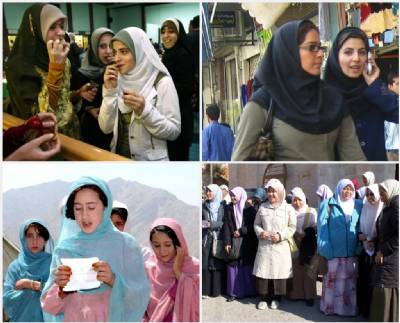
Photograph: Women and girls in hiyab, from Wikipedia