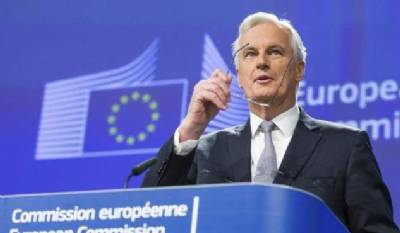
European Commissioner for Brexit at Moncloa meeting: “Britain has to pay its dues, or it gets no deal”
European Commissioner for Brexit at Moncloa meeting: “Britain has to pay its dues, or it gets no deal”
SPANISH president Mariano Rajoy met with European Commissioner for Brexit this week to give his 'full support' to EU officials throughout the process – and heard that if Britain does not pay up, it will get no deal.
Michel Barnier (pictured) was on a visit to the Moncloa Palace, Spain's answer to the White House and 10 Downing Street, when he issued this warning to the UK before reporters.
“The British have decided to abandon the single market and the customs union, and will have to bear the full consequences of this,” Barnier stressed.
“We need to work hard to build the framework of our future trade relations, with an ambitious and fair agreement between both parties and a new level of cooperation beyond that, covering universities, international and national security, terrorism, global operations and peace processes.
“But this divergence could become very difficult if such negotiations do not cover issues like environment, consumer protection and taxation.”
Concerning recent reports that the UK allegedly stated it 'would not pay' the 'divorce' settlement, estimated to be in region of €100 million but which will need to be thrashed out between both parties, Barnier said Britain had two choices.
“The British have got to pay what they owe,” he stipulated.
“If they don't pay, if nobody wants to pay, the only option instead – and not one I wish for at all – would be a clean break from all programmes.
“That would be absolutely catastrophic, so we kindly request the British to settle their accounts, as a solution and an agreement is necessary: this is an extraordinarily sensitive issue.”
Barnier, who met with Rajoy and with his right-hand woman Soraya Sáenz de Santamaría, explained that the EU's seven-year budget programme included joint projects that would benefit citizens of all member States, 'including the UK', given that triggering Article 50 does not mean Britain is already out of the Union as it has up to two years to bring the severance to fruition.
But the remaining 27 member States are not prepared to agree a long list of different deals on different subjects, or as individual nations.
“Any deal will be a single one in the name of the EU as a bloc, and it will be serious and complex, as European negotiators are concerned above all with protecting the rights of the remaining 27,” Barnier told Spain's government.
He stresses that the EU is 'not trying to get revenge on or punish' the UK for leaving, nor to 'make an example' of the country, but that it will simply put its own interests first, in the same way as Britain will.
He added that he did not wish to hear the debate being considered as 'a sign of the EU's future uncertainty' – in fact, reports to date show that the EU-27 are pulling together more than ever now as a result of Brexit, with some even saying the UK's departure is a pòsitive step because Britain 'never really believed in the European project', which was always destined to hinder its progress.
Barnier is, however, concerned that the two-year deadline is 'extremely tight' for any settlements and deals to be struck, especially since some kind of agreement is needed between April and November 2018 to give time for loose ends to be tied up before the final departure.
Among the numerous issues this early settlement depends upon is that of air travel: Ryanair bosses recently explained that airlines typically schedule flights up to a year in advance, meaning some disruption to traffic between the UK and EU could ensue unless the firm had a clear route map by April 2018 at the very latest.
The two-year deadline is not, despite common misconceptions, in place to facilitate a trade deal between the EU and the outgoing member State, but is purely to settle accounts and divide assets – any decisions on future relationships are entirely separate from this and departure must happen by the end of the two years, deal or no deal.
Crucially, Barnier told Rajoy and Sáenz de Santamaría that the main priority in any negotiations would centre on the rights and legal security of 'the 3.2 million EU nationals living in the UK and the 1.2 million Brits living in the EU'.