Economy minister agrees to Ciudadanos' ultimatum on lowering taxes in exchange for spending cap vote
Economy minister agrees to Ciudadanos' ultimatum on lowering taxes in exchange for spending cap vote
SPAIN'S economy minister Cristóbal Montoro has agreed to lower income tax next year in exchange for the opposition agreeing to his cap on public spending.
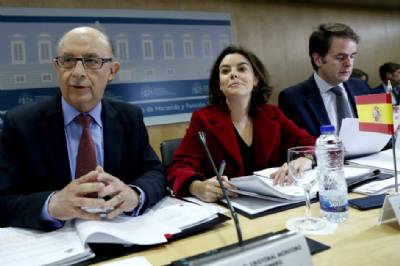
Montoro (pictured left, next to vice-president Soraya Sáenz de Santamaría, centre) wanted to raise the limit on what the country's 17 regional governments could spend by around 1%, to just under €120 billion, but the minority-led right-wing PP cabinet was accused of being ungenerous by the mostly-left wing opposition.
Centre-right Ciudadanos, however, agreed to vote in favour – giving the new spending cap a majority support enough for it to go through – as long as Montoro reduced income tax for 2018.
He had not planned to do this until 2019, when the next general elections are due.
Just three weeks ago, Montoro had argued there was 'no margin' to allow for cutting taxes and alleviating the financial burden on the working and middle classes.
But in an about-turn last night (Wednesday), Montoro has bent under pressure and, next year, the population of Spain will save themselves around €2bn.
As yet, the specifics have not been agreed – Ciudadanos says the tax cuts will benefit 'those on the lowest incomes', but at the same time has referred directly to 'the middle classes': those not living in extreme below-the-breadline conditions, but who still have to watch every cent and have little or nothing left after paying all their bills every month.
Some of the new tax régime could involve increasing tax deductions for maternity and disability, which currently only sit at €100 a month, and upping the minimum threshold or 'personal allowance' of €12,000 a year, below which individuals are not subject to tax.
“The tax reductions will be applied to those social groups who most need to feel the effects of Spain's economic recovery,” said Montoro, making it clear that any general tax cuts would still be held off until election year to show the PP in a good light.
Even with Ciudadanos' vote in favour, however, the new spending cap cannot go through without another handful of votes in favour: the PP has 137 MPs, Ciudadanos 32, giving 169, but for a majority a total of 176 is needed out of the 350 seats in Parliament.
The PSOE (socialists), led once again by Pedro Sánchez, have already said they will vote against the cap, as it is not enough – in some regions, such as Andalucía, the increase in spending allowed is only around 0.4%, whilst attempts to 'sweeten' Cantabria and Catalunya have led to their being granted an additional annual margin of €1.1bn each.
This means the minority regional parties in the Basque Country and the Canary Islands will be needed to provide the remaining seven votes for the spending limit to be approved.