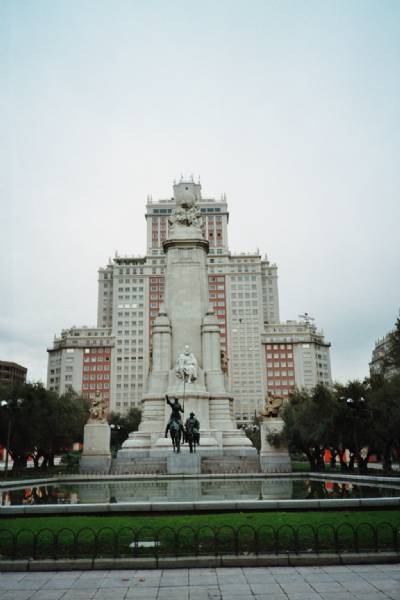
MADRID'S iconic Plaza de España building will finally open as a four-star hotel in summer 2019 under management of the international holiday resort chain Riu.
Major renovation works – which the company desscribed as 'a great challenge' for its technical team – started on October 23 last year after months of redrafts of the eventual hotel design, which had to include all creature comforts whilst 'retaining all the historic elements' of the huge tower block, says CEO Carmen Riu.
It will be Riu Hoteles' first branch in Madrid and its 'flagship' in Spain, Carmen says – a 3,000-square-metre complex with 589 suites and 15 meeting rooms, complete with facilities for social events, parties and corporate occasions.
In addition to all this, a further 1,600-square-metre open-plan room will be built to cater for events with capacity for up to 1,000 people.
A gastro-pub in reception, two restaurants and a 'sky bar' on the penultimate floor – the 25th storey – plus a 500-square-metre terrace with a swimming pool on the roof, above the 26th floor, are also on the cards.
The 'sky bar' and pool terrace will offer unrivalled panoramic views across the whole of the city of Madrid, according to Carmen.
Riu currently has six urban resorts, its Riu Plaza Hotels, worldwide – the first opened over seven years ago in Panamá City, and the other five have gone up since in Guadalajara in western México, Miami, New York, Berlin and, more recently, Dublin.
Riu Hoteles bought the Plaza de España block – known as the 'Edificio España' ('Spain Building') – just before summer 2017, purchasing it from the Murcia-based firm Trinitario Casanova, who had acquired it from the Chinese company Wanda Group.
Trinitario initially loaned the building to Riu to turn into a hotel, but the chain then decided to buy it, although the Murcia company was involved in the renovation project and will use the first three storeys and the shopping area.
Before the two-year revamp started, the Edificio España had sat empty and abandoned for 11 years, with ongoing maintenance works carried out just to stop it falling to rack and ruin – in fact, for most of 2008 and 2009, tourists from elsewhere in the world who flocked to see it found it covered in scaffolding.