11 min read
Spain’s Semana Santa (Holy Week) is not merely a holiday; it is a profound cultural immersion, an open-air museum of 16th-century artistry, and a visceral display of emotion. Far removed from the chocolate eggs and Easter bunnies prevalent in much of Northern Europe and the Americas, the Spanish observance is a deeply sensory spectacle. It is the scent of burning incense and orange blossoms in the spring air, the rhythmic pounding of a solitary drum, the collective gasp of a crowd as a massive golden float navigates a narrow medieval corner, and the heartbreaking wail of a solitary flamenco prayer piercing the night.
This year, Semana Santa runs from Sunday, March 29th (Palm Sunday) to Sunday, April 5th (Easter Sunday).
To help you understand the depth of this festival, here is your definitive guide to Spain’s Holy Week traditions, typical gastronomy, and the most pivotal cities to witness the processions in 2026.
The architecture of a procession: Traditions, brotherhoods, and vestments
To the uninitiated, the visual elements of a Spanish Holy Week procession can be surprising, mysterious, and occasionally overwhelming. Understanding the mechanics and the history behind the spectacle transforms the experience from a mere parade into a moving piece of living history.
Hermandades and cofradías
The backbone of Semana Santa is the brotherhood (hermandad or cofradía). Some of these organisations date back to the 13th and 14th centuries. Historically formed as mutual aid societies for specific trades (such as bakers, sailors, or silversmiths), they are deeply embedded community groups. Members dedicate the entire year to preparing for their specific procession, maintaining the floats, and organising charitable works.
Los pasos and tronos (The floats)
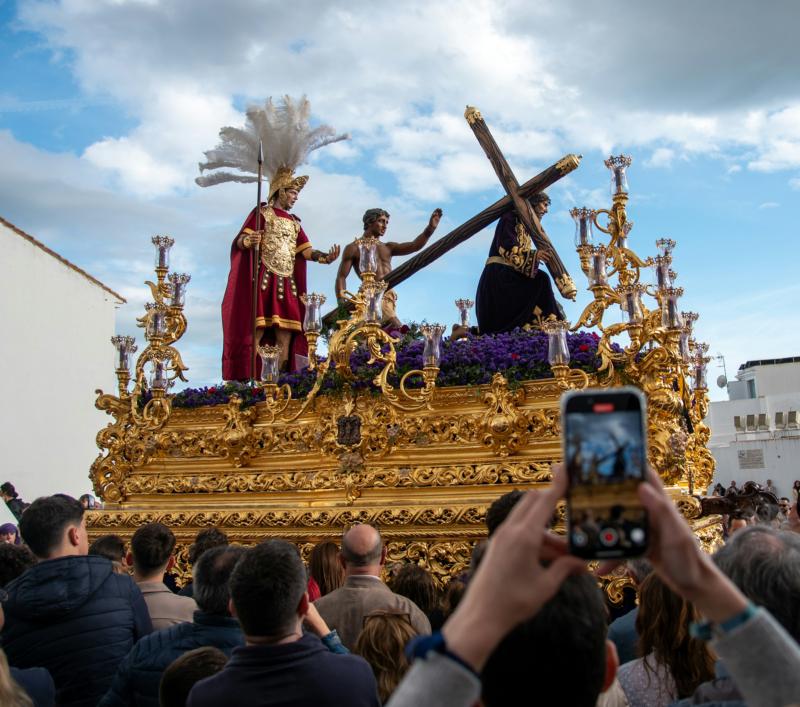
At the centre of every procession is the paso (in Andalusia) or trono (in Malaga). These are monumental, intricately carved wooden floats depicting scenes from the Passion of Christ or the sorrow of the Virgin Mary.
- The artistry: Many of the statues carried atop these floats were carved by masters of the Spanish Renaissance and Baroque periods, such as Juan de Mesa, Pedro de Mena, and Francisco Salzillo. They are priceless works of art, temporarily brought out of the basilicas to walk among the people.
- The ornamentation: The floats are heavily adorned with silver, gold leaf, and thousands of fresh flowers—typically red carnations for Christ (symbolising blood and passion) and white roses or orchids for the Virgin Mary (symbolising purity). Hundreds of thick wax candles illuminate the statues as night falls.
Costaleros and the capataz
A paso does not roll on wheels; it is carried by human devotion. The costaleros are the men (and increasingly women) who bear the immense weight of the floats, which can exceed a metric ton.
- They carry the structure on their shoulders or the backs of their necks, often hidden entirely beneath the drapery of the float.
- They wear a faja (a tight, wide belt) to protect their lower backs and a costal (a padded cloth headdress) to cushion the weight.
- Because they cannot see outside, they are guided by the capataz (the overseer), who uses a llamador—an ornate metal knocker on the front of the float—to signal when the costaleros should lift, step, or halt. Their synchronised, rhythmic swaying to the beat of a marching band is known as giving the float "life," making the statues appear to walk.
Nazarenos and penitentes
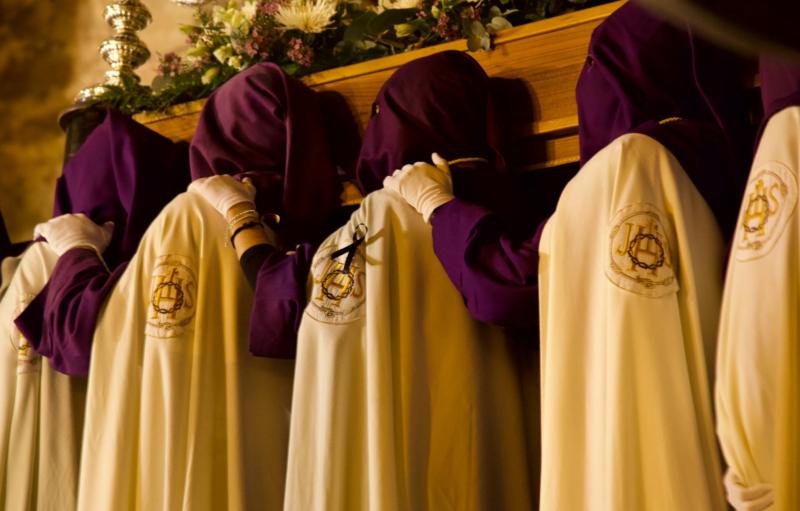
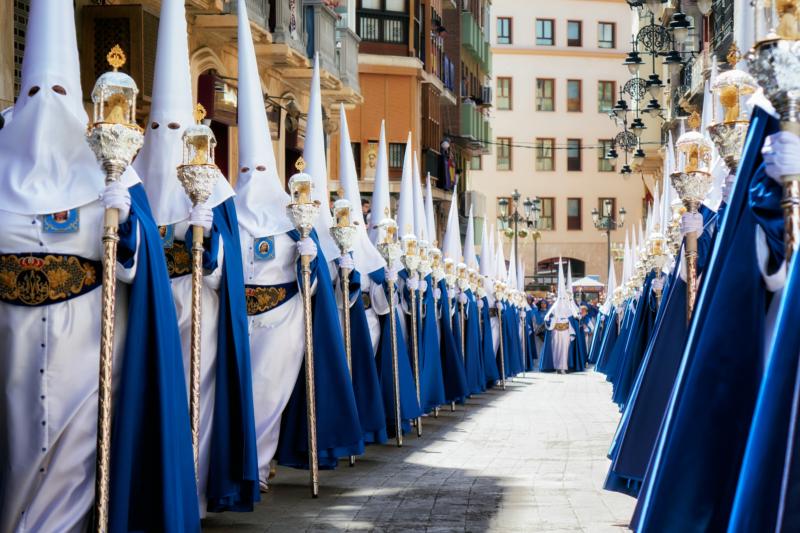
Marching ahead of the floats are the nazarenos (penitents), creating one of the most striking visual images of Semana Santa.
- The capirote: They wear long cloaks and the iconic capirote—a tall, conical hood that covers the face, leaving only two holes for the eyes.
- Historical context: It is vital to note that this vestment originated during the Spanish Inquisition as a symbol of anonymous penance. The cone shape symbolically points the wearer towards heaven to ask for forgiveness. It is a strictly religious Spanish tradition that predates and has absolutely no association with hate groups in the United States.
- Penitence: Some participants take their penance incredibly seriously, walking the multi-hour routes entirely barefoot, carrying heavy wooden crosses, or even dragging iron chains attached to their ankles in the silence of the night.
The soundscape: Saetas and marches
A procession is defined as much by its sound as its sight. Behind the floats march massive brass and drum bands (cornetas y tambores). They play specific, slow, and dramatic marches that dictate the pace of the costaleros. Occasionally, the entire procession will come to a dead halt. From a dark balcony above, a singer will break into a saeta—a spontaneous, heartbreaking, a cappella flamenco prayer sung directly to the statue. The crowd remains in absolute, pin-drop silence until the song concludes, erupting into applause as the float moves on.
Semana Santa gastronomy: What foods are eaten during Holy Week in Spain?
Because Catholic fasting traditions restrict meat during Lent, Spanish Holy Week cuisine pivots to rich vegetarian dishes, hearty seafood, and energy-dense sweets designed to sustain the penitents.
Traditional Easter food in Spain
- Potaje de vigilia: The ultimate Good Friday "vigil stew," made with slow-cooked chickpeas, fresh spinach, and chunks of salt cod.
- Bacalao (Salt cod): The staple protein of the season, widely enjoyed as crispy croquettes (croquetas de bacalao) in local tapas bars or stewed in rich tomato sauces.
- Tortilla de patatas: In central Castile and León, families gather outdoors on Jueves de Tortilla (Tortilla Thursday) to share classic Spanish omelettes before Good Friday's solemnity sets in.
- Empanada gallega: Galicia's portable double-crusted pies, heavily favoured during Lent when stuffed with a rich sofrito and local tuna or codfish.
- Morteruelo: A rare meaty exception found in Cuenca. Eaten as an aperitif, this rich, pâté-like stew is made from local game meats, breadcrumbs, and regional spices.
Spanish Holy Week sweets
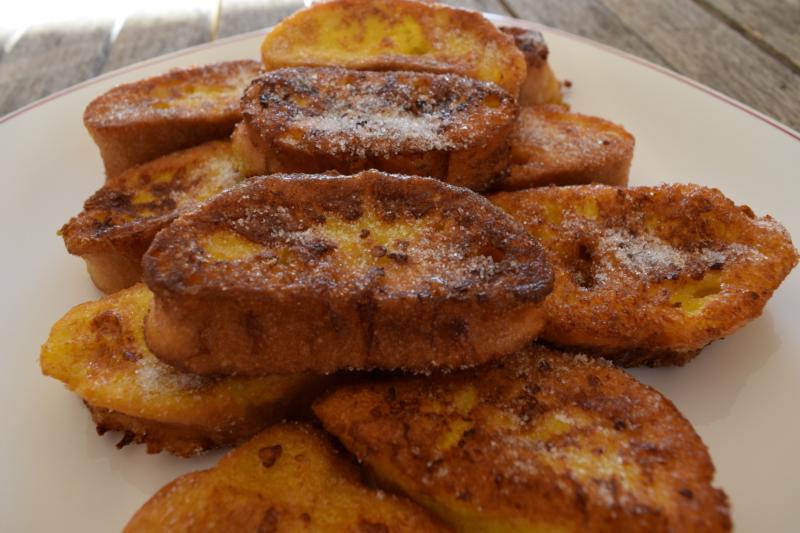
- Torrijas: Spain's absolute favourite Easter sweet. Thick slices of day-old bread are soaked in lemon-infused milk or sweet wine, fried in virgin olive oil, and coated in cinnamon sugar or local honey.
- Rosquillas: Popular in Andalusia, these crispy, ring-shaped fried dumplings are dusted in sugar and dipped in honey, providing a massive sugar rush for procession marchers.
- Mazapán: In Toledo, marzipan is a spring staple. Intricate animal and religious figures are expertly crafted from equal parts ground almonds and sugar.
- Mona de Pascua: The star of Easter Sunday in Catalonia and the Valencian coast. Traditionally, a sweet brioche cake topped with hard-boiled eggs, modern versions feature elaborate chocolate sculptures gifted by godparents.
- Fartons and horchata: In Valencia and Elche, warm procession-watchers cool down by dunking sweet, spongy fartons (breadsticks) into ice-cold horchata (a milky beverage made from crushed tiger nuts).
Key dates for Semana Santa in Spain (2026)
This year, Semana Santa runs from Sunday, March 29th (Palm Sunday) to Sunday, April 5th (Easter Sunday).
| Date (2026) | Spanish Name | English Name |
| Sunday, March 29 | Domingo de Ramos | Palm Sunday |
| Thursday, April 2 | Jueves Santo | Maundy Thursday |
| Friday, April 3 | Viernes Santo | Good Friday |
| Sunday, April 5 | Domingo de Resurrección | Easter Sunday |
| Monday, April 6 | Lunes de Pascua | Easter Monday |
Significance & what to expect
- Palm Sunday: Marks the official start of Holy Week. You will see crowds and processions featuring intricate woven palm fronds (palmas blancas), particularly famous in Elche and Alicante.
- Maundy Thursday: A public holiday in most Spanish regions (though often not in Catalonia or Valencia). This evening kicks off the most intense and emotional overnight processions, such as La Madrugá in Andalusia.
- Good Friday: A national public holiday across all of Spain. This is the most solemn day of the week, characterised by silent, mournful processions and traditional meatless meals like Potaje de Vigilia. Expect widespread business closures.
- Easter Sunday: The mood shifts entirely to joyous celebration. Church bells ring, mourning veils are replaced with bright colours, and families gather for large feasts and desserts.
- Easter Monday: A regional public holiday in areas with heavy expat populations, including the Valencian Community, Catalonia, and the Balearic Islands. This is traditionally the day godparents gift the Mona de Pascua cake.
Where to go: The best places to experience Semana Santa in Spain
Every town, village, and city in Spain holds processions, but a select few are declared festivals of International Tourist Interest. Here are the most spectacular places to experience the 2026 celebrations, including deep dives into both iconic Andalusian centres and prominent expat hubs along the coast.
1. Seville (Andalusia)
Seville is the undisputed world capital of Semana Santa. The entire city shuts down to accommodate over 60 brotherhoods navigating the labyrinthine, narrow streets of the historic centre toward the massive Gothic Cathedral. The sheer scale, scent of incense, and devotion are unmatched.
- Key dates & procession: La Madrugá (The Dawn). Taking place from midnight on Maundy Thursday (April 2) well into the late morning of Good Friday (April 3), this is the climax of Seville's week. Over 500,000 people take to the streets to witness the city's most deeply revered statues. Watch in awe as the Gran Poder (Great Power) moves through the streets in absolute silence, and contrast it with the roaring, joyful crowds throwing rose petals as La Macarena (the city's beloved Virgin) emerges from her basilica.
2. Malaga (Andalusia)
Malaga’s processions are characterised by their colossal size, open joy, and deep ties to the Spanish military. The floats here are not called pasos but tronos (thrones), and they are so massively wide they cannot fit into the cathedral, requiring up to 250 men carrying them on the outside via long poles.
- Key dates & processions: On Holy Wednesday (April 1), witness the tradition of El Rico. By a royal decree issued by King Carlos III, this brotherhood has the right to pardon and free an actual, real-life prison inmate during the procession. On Maundy Thursday (April 2), thousands gather at the port to watch the Spanish Legionnaires disembark. They march through the city at a rapid, 160-step-per-minute pace while singing the haunting anthem El Novio de la Muerte (The Bridegroom of Death) to accompany the Cristo de la Buena Muerte.
3. Granada (Andalusia)
Set against the dramatic backdrop of the snow-capped Sierra Nevada mountains and the majestic Moorish Alhambra, Granada offers an intimate, deeply atmospheric, and deeply flamenco-rooted experience.
- Key date & procession: Holy Wednesday (April 1). The procession of the Cristo de los Gitanos (Christ of the Gypsies) makes its way out of the city centre and up the steep, winding hills into the Sacromonte neighbourhood. As the float passes the traditional cave houses, huge bonfires (chíscos) are lit in the hills. The night air fills with the sounds of impromptu flamenco singing and dancing, creating an atmosphere that feels ancient and magical.
4. Murcia (Region of Murcia)
For the large expat communities in the Costa Blanca South and the Costa Cálida, the capital city of Murcia offers one of Spain's most unique, interactive, and celebrated Holy Weeks, deeply tied to the region's agricultural roots (the huerta).
- Key dates & processions: On Holy Wednesday (April 1), the streets fill with the procession of Los Coloraos (named for the blood-red robes of the penitents). In a tradition entirely unique to Murcia, the nazarenos wear distended robes whose bellies are stuffed full of broad beans, hard-boiled eggs, small sweets, and monas, which they pull out and hand to the children in the crowd.
- On Good Friday morning (April 3), the tone shifts to high art. The Procession of the Salzillos takes to the streets. The floats carried here are the actual, priceless masterpieces carved by the 18th-century Murcian master sculptor Francisco Salzillo. It is literally a world-class museum, walking through the morning sunlight.
5. Alicante and Elche (Valencian Community)
Also serving the massive expat populations of the Costa Blanca, Alicante, and its neighbouring city of Elche offer incredible spectacles that fuse religious devotion with local heritage.
- Key Dates & Processions: Elche kicks off Semana Santa on Palm Sunday (March 29). The city is home to Europe's largest palm grove (a UNESCO World Heritage site). Rather than simple branches, participants carry massive, intricately woven white palm fronds (palmas blancas) in a spectacular display of local craftsmanship.
- In Alicante, the must-see event is on Holy Wednesday (April 1) in the Santa Cruz neighbourhood. The brotherhoods must navigate incredibly steep, narrow, winding staircases to bring their floats down from the hermitage on the slopes of Mount Benacantil. The sheer physical peril and the skill of the costaleros drawing the floats down the steps elicit gasps and cheers from the tightly packed crowds.
6. Valencia (Valencian Community)
Valencia’s central city offers a distinct flavour with its Semana Santa Marinera (Maritime Holy Week). It is deeply rooted in the historical fishing districts of El Cabanyal, Canyamelar, and El Grao.
- Key dates & processions: The maritime connection is ever-present; instead of just traditional brotherhoods, you will see participants dressed in historical military uniforms and the prominent display of the "Christ of the Fishermen." On Good Friday (April 3), the Holy Burial procession sees locals walking in solemn silence toward the beach, a tribute to those lost at sea. However, on Easter Sunday (April 5), the solemnity breaks spectacularly into celebration. In the Resurrection Parade, participants throw flower petals, the mournful black veils are ripped away to reveal brilliant white clothing, and the streets explode with Mediterranean joy.
7. Zamora and Valladolid (Castile and León)
For those who wish to step away from the joyful clamour of the south and experience something fundamentally older, sombre, and deeply spiritual, the processions of Castile and León offer an unparalleled contrast.
- Key dates & processions: Throughout Good Friday (April 3), the medieval streets of Zamora and Valladolid are transformed. There is almost no brass band music here. The processions are held in absolute, chilling silence, broken only by the rhythmic strike of staffs on the cobblestones, the sound of horses' hooves, or the ethereal echoes of a choir chanting in Gregorian Latin. The statues carried here are raw, visceral, and starkly realistic masterpieces of 16th-century Renaissance sculpture, offering an intense, introspective experience that leaves observers breathless.
8. Cuenca (Castilla-La Mancha)
A dramatically positioned medieval city perched on the edge of a gorge, Cuenca offers an incredibly intense Good Friday experience.
- Key tradition: On the night of Good Friday, the city falls silent for the Trompeta de la Muerte (Trumpet of Death). A lone trumpeter plays a mournful, haunting solo from the high tower of a local church, echoing across the ravines as a stark symbol of Christ's passing.
9. Galicia (Northwestern Spain)
Far from the Mediterranean, the Celtic-influenced region of Galicia has its own distinct way of marking the end of Holy Week.
- Key tradition: Melding pre-Christian and Catholic traditions, the night from Holy Saturday to Easter Sunday is marked by the "burning of the witches." Locals build massive bonfires and burn straw dolls representing witches and evil spirits. The act of burning the effigies is widely believed to cleanse the towns, ward off evil, and bring good fortune for the coming spring season.
Experiencing Semana Santa in Spain is to understand the country's soul—a perfect, dramatic collision of history, art, community, and unbridled emotion. Regardless of which region you choose to explore in 2026, the memories of the incense, the music, and the monumental floats navigating the Spanish night will stay with you long after the final torrija has been eaten.
Fallen in love with Spanish culture this Semana Santa? If experiencing the magic of Holy Week has you dreaming of making Spain your permanent home, we are here to help. Discover essential tips, legal advice, and cultural insights in our comprehensive guide to Living in Spain.

Last updated: 27/03/2026
Was this article useful?
Related Topics
Related Articles