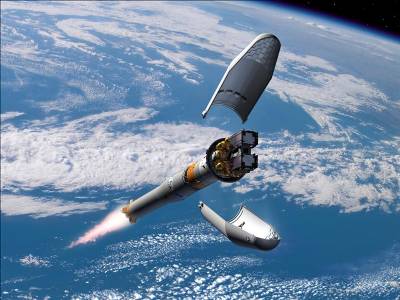
Two Galileo satellites, the European Union's answer to the American GPS system, were launched by a Russian Soyuz rocket from its new base in French Guiana at 7.30am local time today.
The European Commission (EC) has invested billions of euros in its own version of the satellite navigation system, which carries more precise atomic clocks than the American version, and it expects Galileo to bring significant returns to EU nations in the form of new businesses that can exploit precise space-borne timing and location data.
It took three hours and 49 minutes for the Soyuz rocket to get the satellite pair into their correct orbit 23,222km above the Earth.
"Galileo is at the heart of our new industrial policy," EC Vice-President Antonio Tajani said once the separation confirmation had come through. "We must commit very strongly to Galileo. We need this; this not entertainment. This is necessary for the competitiveness of our European Union in the world."
Mr Tajani then announced the industrial competition to procure 6-8 more satellites over and above the 18 already contracted.
The two spacecraft launched on Friday are pathfinders for the Galileo system as a whole. Sat-nav users themselves will not immediately see any benefits from Galileo, however. It is likely to take almost a decade to achieve a full deployment of the Galileo system and it is likely to be 2015 before there are enough spacecraft in orbit for Galileo to start to show its true capability.