
Movístar launches phone App to prevent car theft
NATIONAL telecomms giant Telefónica has created an anti-car theft phone App for less than the cost of a glass of wine per month.
Sign in/Register
Looking for the Professionals/Advertiser Login?
By Signing up you are agreeing with our Terms and Privacy Policy.Forgot your password?
Feedback is welcome

But he pointed out Spain is one of the countries in Europe with the fewest yihad, or Islamic 'holy war' would-be terrorists leaving for recruitment in Syria and Iraq, and the fewest returning.
Only 'a few dozen' fundamentalists from Spain go to war zones for indoctrination and 'only one or two' come back to the country, but 'no nation is free from being the target of an attack at any time', since many others have committed suicide bombings whilst out there, Fernández Díaz stated at the G6 Interior Minister Summit in Barcelona this week.
“Concerns are growing about how yihad 'warriors' are returning to the European countries they left from, duly brainwashed and trained in front-line combat, to be potential terrorists who may commit attacks,” the Spanish minister commented.
So far, 'only three' have been arrested in Spain upon their return from Iraq, Syria and Mali, whilst in other European nations such as the UK, 'hundreds' travel out to areas of conflict and 'dozens' return, said Fernández Díaz.
In fact, the British government and police have started a campaign to convince family members and friends of would-be Islamic fundamentalists to report the matter, promising that this will 'not necessarily lead to their ending up in prison' – although Muslim community leaders fear the police are not the right parties to lead the initiative as they appear 'threatening' to many of their members.
But Spain has a long tradition of terrorism and the specialist knowledge and means to fight it, after decades of bloodshed at the hands of Basque separatist cell ETA, which has not been actively violent since summer 2009.
Fernández Díaz insists he is not trying to 'create alarm', merely to 'be realistic', and called for a united front among the G6 countries – Spain, the UK, Italy, Germany, France and Poland.
Representatives from other nations will be invited when future strategies are discussed, particularly Turkey since it is a NATO ally and ongoing applicant to join the EU, as well as sharing a border with Syria and being used as a transit route to the war-torn country.
The G6 Summit also discussed drug-trafficking and ways of stepping up the fight against dealing and smuggling, with the help of the USA.
According to Jorge Fernández Díaz, the illegal industry sees a turnover of 300 billion euros worldwide every year, of which six billion change hands in Spain.
And 40 per cent of all cocaine, plus three-quarters of the cannabis, confiscated in drug raids in Europe is seized in Spain.
Additionally, a third of the world's cannabis haul is found in Spain and the dealing and smuggling industry makes 18 million euros a day in the country.
Drug-trafficking needs to be stopped, stressed the ministers present – not only because of the health dangers posed to users, but because of the industry's inextricable links with sex-slavery, arms dealing, exploitation of immigrants, human trafficking, money-laundering and other organised crime.
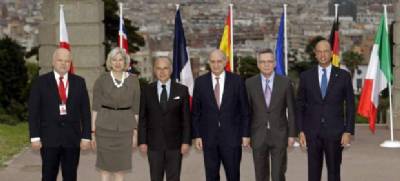
Photograph: Jorge Fernández Díaz, interior minister for Spain, third from right along with the Secretary of State for the Interior in Poland, Piotr Stachanczyk (far left), and the ministers of the interior for the UK (Theresa May, second left); France (Bernard Cazeneuve, third left); Germany, (Thoms de Maiziere, second right), and Italy (Angelino Alfamo right), at the end of the first day of the G6 conference at the Albéniz Palace in Barcelona
NATIONAL telecomms giant Telefónica has created an anti-car theft phone App for less than the cost of a glass of wine per month.

A MAN declared dead at his home in the province of Tarragona was on his way to the funeral parlour when he turned out to be alive, according to police sources.

A SICILIAN mafia 'godfather' who had been on the run for 20 years was captured in Madrid thanks to a photo on Google Maps, police say.

A NEW child protection law named after a British musician living in Spain has been approved in Congress and is set to be signed off by the Council of Ministers on Tuesday, June 8.