Flamenco guitar veteran Paco de Lucía immortalised in guided tour of Algeciras
Flamenco guitar veteran Paco de Lucía immortalised in guided tour of Algeciras
FANS of Spain's most international flamenco guitar legend Paco de Lucía can take a tour of his regular haunts in the southern region of Andalucía.
The late musician was considered a genius in his field by world-famous artists – in fact, Mark Knopfler once said that after he had heard Paco de Lucía play, “I realised I couldn't play the guitar.”
But visitors to the port town of Algeciras (Cádiz province) can now go on a guided tour of Paco's life – starting at the house where he was born on the C/ San Francisco, where he lived until he was five years old.
The route continues along the C/ Munición, which was once full of bars where Paco de Lucía's father, Antonio Sánchez Pecino, played regularly and which the artist himself immortalised in his album Luzia, named after his Portuguese mother Lucia Gomes Gonçalves.
Back in Paco de Lucía's youth, the upper-class residents of the C/ Munición would organise high-society parties that went on for days – and although his father Antonio did not enjoy them in the slightest, it enabled him to earn a crust and get free wine and tapas as a perk of the job, supplementing his income from his fruit stall in the market and his work as a travelling seller of fabrics.
Although the parties attracted the crème de la crème of society, the revellers were not always very well-behaved – Paco de Lucía later related with horror how he saw his dad return home crying because one of the upper-class partygoers had kicked his guitar and broken it into pieces.
Paco's fans continue their tour into the former council meeting room in the town hall, where the musician was named 'Adoptive Son' of Algeciras in 1998 and where his wake was held after his death, last February at the age of 66 whilst playing football with his son Diego near his home in Playa del Carmen, eastern México.
The Plaza Alta in Algeciras, one of its most iconic sites, forms part of the 'Paco tour' route – the artist dedicated a song to it in his album Almoraima, and used to play there with other children when he was little.
Nearby, the C/ Muro was also mentioned in one of Paco's albums, Siroco, released in 1987.
Naturally, the market place where the family fruit and cloth stalls were based – the Plaza de Abastos, or auction exchange – is included on the tour, being a part of the town where Paco spent many years as a child and young man learning to do his father's book-keeping and to write in calligraphy.
The El Chorruelo beach, in front of the Hotel Reina Cristina – a luxury establishment and the most expensive in Spain at the time, where famous American film stars and crew, English politicians and the Spanish nobility regularly stayed – comes next, followed by the Getares beach where sculptor Nacho Falgueras built a statue of Paco.
Scenery which inspired Paco de Lucía's music can be taken in from the Punta del Faro ('lighthouse point) atop Getares bay, alongside the Bernardo House – the title of one of his rumba tracks – and a bar on the El Rinconcillo beach where Paco's family's summer house was based.
From the lighthouse, on a clear day, views of white sands on the north African coast are clearly seen, with the choppy Atlantic to the west and the millpond-calm Mediterranean to the east – in fact, Algeciras is the main Spanish port leading to Africa, with ferries running to Tangiers and Tetouan in Morocco, and the Spanish-owned city-provinces of Ceuta and Melilla on its coast.
Paco de Lucía was also inspired by the countryside surrounding the Río de la Miel (literally, 'honey river') which runs through the Luna mountain range and forms the Isla Verde, or 'green island' which was where Algeciras' main hub used to be centuries ago.
The Isla Verde was known in the Moorish times, when much of Spain was occupied by Arabs, as Al-Yazirat al-Hadra, which is where its modern-day name of Algeciras comes from.
Paco de Lucía's last resting place may be a sombre, wistful end to the tour, but is an essential pilgrimage for his fans – the San José patio in the old cemetery, a place where his followers, often visitors from abroad, leave abundant flowers almost daily.
More information about guided tours can be found on the website cadizturismo.com.
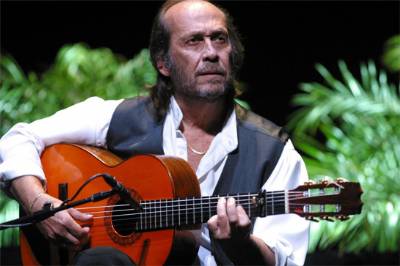
Photograph 1: Paco de Lucía doing what he did best, playing the flamenco guitar
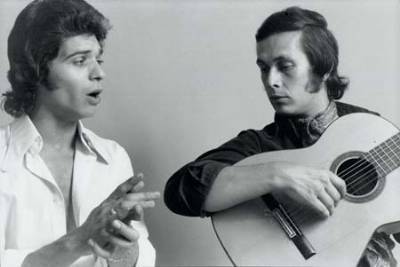
Photograph 2: Paco with his lifelong friend and musical partner, Camarón de la Isla
Photograph 3: Paco on his wedding day in Amsterdam, when he married Casilda Varela in 1977 - the couple separated 20 years later after having had three children, Casilda, Lucía and Francisco, and Paco later married Mexican restaurateur Gabriela Canseco in Cancún. They had two children: Antonia, aged 14 and Diego, aged eight